
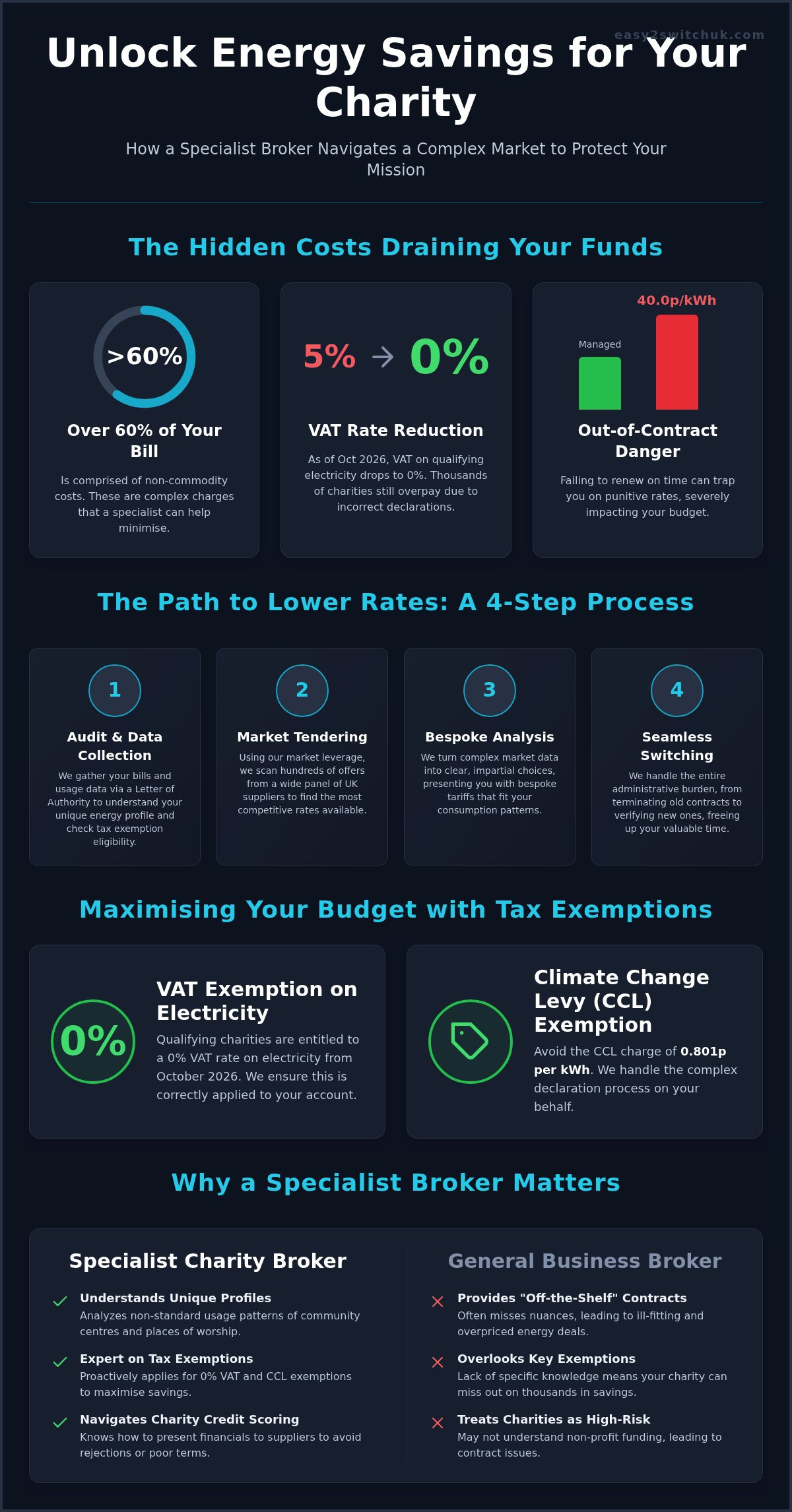
Did you know that as of October 2026, the VAT rate on qualifying electricity supplies for charities has dropped to 0%, yet thousands of non-profits are still paying significantly more than they should? It’s a staggering reality in a market where non-commodity costs now account for over 60% of your total bill. Partnering with a dedicated charity energy broker ensures you aren’t just another account number lost in the system, but a protected organisation with optimised costs.
We understand that managing a charity is a full-time commitment, and the last thing you need is the stress of volatile energy markets or the confusion of Climate Change Levy (CCL) declarations. It’s exhausting to watch funds meant for your core mission being drained by utility providers. This guide will show you exactly how to reclaim those funds by securing lower rates and applying for the tax exemptions you’re legally entitled to. We’ll walk through the 2026 regulatory changes, explain how to navigate the 0.801p per kWh CCL rates, and demonstrate how a professional switching service can handle the entire process for you. By the end, you’ll have a clear path to reducing your overheads and regaining financial control.
Key Takeaways
- Understand how a specialist charity energy broker identifies unique usage profiles and bespoke tariffs that generic commercial brokers frequently overlook.
- Discover how to capitalise on the 2026 VAT reduction to 0% for electricity and secure vital Climate Change Levy (CCL) exemptions for your non-profit.
- Learn how a streamlined procurement process uses a Letter of Authority to scan hundreds of supplier offers, saving your staff valuable time and effort.
- Identify the red flags of unreliable brokers and why transparency in commission structures is essential for maintaining your charity’s financial integrity.
- See how impartial consultancy can turn complex market data into clear choices, ensuring more of your budget remains dedicated to your core mission.
What is a Charity Energy Broker and Why Does Your Non-Profit Need One?
A charity energy broker serves as a vital bridge between your non-profit organisation and the complex UK energy market. Essentially, they are specialist consultants who negotiate with suppliers to secure the most cost-effective gas and electricity contracts. For those asking What is an energy broker?, it’s an expert who uses market knowledge and industry relationships to find better deals than a customer could find alone. While a standard business might focus solely on the bottom line, a charity broker understands that every pound saved on utilities is an extra pound for your core mission.
Charities don’t operate like standard commercial offices. You might manage a community centre that’s empty on weekdays but bustling on weekends, or a place of worship with massive heating requirements for just a few hours a week. Generic brokers often miss these nuances, leading to “off-the-shelf” contracts that don’t fit your actual consumption patterns. A specialist broker provides the market leverage that a single small charity simply can’t command, pooling sector-specific data to get you the same preferential treatment as a major corporation.
The Role of an Energy Consultant in 2026
The energy landscape in 2026 remains unpredictable. Wholesale prices can shift overnight based on global events, making the timing of your renewal critical. An expert consultant monitors these fluctuations constantly, ensuring you lock in rates when the market dips rather than waiting until your current contract expires. This proactive approach prevents you from falling onto expensive out-of-contract rates, which can reach 40.0p per kWh for electricity.
Beyond timing, they provide impartial advice across a wide panel of UK suppliers. This isn’t just about finding the lowest number; it’s about managing the entire administrative burden. From terminating old contracts to verifying your new meter readings, the broker handles the paperwork so your team can focus on their charitable work. It’s a done-for-you service that replaces confusion with clarity.
Why General Business Brokers May Fail Charities
Many general brokers lack the specific expertise required for the third sector. For instance, they might fail to apply for the 0% VAT rate on electricity that many charities qualify for as of late 2026. This oversight alone can cost your organisation thousands of pounds. Specialist brokers also understand the unique hurdles of charity credit scoring. Traditional suppliers often view non-profits as high-risk due to their reliance on grants or donations.
A charity energy broker knows how to present your financial data to suppliers to ensure you aren’t rejected or forced into restrictive payment terms. They also account for the seasonal peaks of community hubs, ensuring your standing charges and unit rates reflect your actual usage rather than a generic business model. By choosing a specialist, you ensure that your specific regulatory needs, such as Climate Change Levy (CCL) exemptions, are handled correctly from day one.
The Energy Procurement Process: How Brokers Secure Better Rates
Securing a lower energy rate isn’t just about finding a cheap number on a comparison site. It’s a structured process that leverages market data and supplier relationships. A professional charity energy broker uses a multi-stage approach to ensure your non-profit isn’t just getting a standard business rate, but a bespoke deal that accounts for your unique operational needs. By following a rigorous procurement cycle, they can strip away unnecessary costs that generic services often miss.
Step 1: The Energy Audit and Data Collection
The journey begins with a thorough audit of your current energy usage. Your broker will gather recent bills to establish your Annual Quantity (AQ), which is the total amount of gas or electricity your site consumes over a year. They’ll also identify whether you have Half-Hourly (HH) or Non-Half-Hourly (NHH) meters, as this dictates which suppliers can quote for your business. The Letter of Authority is the legal bridge that allows your chosen broker to communicate directly with suppliers on your behalf. During this phase, it’s also common to check your eligibility for charity VAT and CCL exemptions, ensuring that any future quotes reflect your true tax status from the start.
Step 2: Market Tendering and Comparison
Once your data is verified, the broker initiates a tender. This involves sending your requirements to a wide panel of providers, ranging from the Big Six to independent green energy suppliers. By forcing these companies to bid for your contract, the broker creates a competitive environment that drives down the unit price. You’ll receive a comparison of fixed-rate contracts, which offer long-term price stability, versus flexible-rate options that might suit larger organisations. The broker doesn’t just look at the price; they evaluate supplier reputations for billing accuracy and customer service to ensure you won’t face administrative headaches later.
Beyond the unit rate, a specialist analyst looks for hidden costs that can inflate your monthly outgoings. This includes scrutinising standing charges and capacity requirements. If your charity has a high kVA (kilovolt-ampere) allowance that you never actually use, you’re paying for capacity you don’t need. Taking a moment to review your current tariff with a professional can reveal where these hidden fees are eating into your budget. This meticulous attention to detail ensures the final contract is lean, accurate, and perfectly aligned with your core mission.
Maximising the Charity Budget: VAT and CCL Exemptions Explained
Every pound your organisation saves on overheads is a pound that goes directly toward your frontline services. While finding a competitive unit rate is essential, tax precision is often where the most significant savings are hidden. A specialist charity energy broker doesn’t just look at the base price; they ensure your non-profit isn’t paying commercial taxes that don’t apply to you. In the UK, many organisations are overpaying by thousands because they haven’t correctly declared their charitable status to their energy supplier.
Qualifying for the 5% VAT Rate (and the 0% Electricity Rate)
Most charities qualify for a reduced VAT rate of 5% on their fuel and power, provided the energy is used for “non-business” purposes. However, a significant change for the 2026/27 period is that from October 1, 2026, to March 31, 2027, the VAT rate on qualifying electricity supplies for charities has been reduced to 0%. This is a notable drop from the previous 5% rate and represents a major opportunity to protect your budget. For gas and other fuels, the rate remains at 5% as of July 2026.
To access these rates, you must provide your supplier with a VAT Declaration Certificate. This isn’t an automatic process; the burden of proof lies with the charity. If you operate in a mixed-use building, such as a charity shop with residential flats above, the rules get more complex. If at least 60% of the energy is used for a qualifying non-business activity, the entire supply can usually be billed at the reduced rate. Your broker will help you calculate these percentages to ensure you’re claiming the maximum relief possible.
Navigating Climate Change Levy (CCL) Relief
The Climate Change Levy (CCL) is a tax on commercial energy use designed to encourage energy efficiency. As of April 1, 2026, the main rates increased to 0.801p per kWh for both electricity and gas. For a large-scale operation like a residential care home or a major community hub, these pennies add up to significant annual costs. Because the market is complex, following Ofgem advice for businesses and non-profits is a good way to understand the regulatory oversight protecting your organisation.
CCL exemption often follows VAT status but requires separate verification to ensure the supplier applies the relief correctly. If your energy usage is very low, you might benefit from “de minimis” thresholds. Supplies below approximately 33 kWh per day for electricity or 145 kWh per day for gas are automatically exempt from CCL and qualify for the 5% VAT rate without a declaration. A charity energy broker will monitor your bills to ensure these triggers are met. If you’ve been overpaying, it’s often possible to make retrospective claims for overpaid tax from previous years, providing an unexpected but welcome boost to your current funds.
How to Choose a Reliable Charity Energy Broker in the UK
Selecting a charity energy broker is a decision that impacts your organisation’s financial health for years. It isn’t just about who provides the lowest number on a spreadsheet; it’s about finding a partner who operates with transparency and professional authority. A reliable specialist will always be upfront about their commission structure. Since most brokers are paid by the supplier, the service is free for the end-user. However, you should avoid any firm that hides how they’re remunerated or pressures you into a deal without explaining the underlying costs.
Experience in the third sector or the farming industry is a strong indicator of competence. These sectors share complex energy needs, such as seasonal usage spikes and specific tax exemptions. If a broker has a proven track record here, they’re more likely to handle your account with the precision it requires. They should also demonstrate access to a wide panel of UK suppliers. If a broker only works with one or two “favourites”, they aren’t creating the competition necessary to drive down your rates. Look for that balance of professional expertise and approachable, neighbourly help.
Red Flags to Avoid in Utility Brokerage
The energy market attracts its fair share of aggressive sales tactics. One major red flag is receiving unsolicited calls from individuals claiming to be from “the national grid” or “your current supplier” to discuss an “urgent” problem with your meter. These are almost always lead-generation scams. You should also be wary of brokers who pressure you into long-term contracts during market peaks. A trustworthy consultant takes a calm, logical approach, helping you time your renewal for when prices are stable rather than when their commission might be highest. Always check for a clear complaints procedure and industry accreditation before signing a Letter of Authority.
Questions Every Trustee Should Ask
Trustees have a fiduciary duty to act in the charity’s best interest. To ensure you’re doing so, ask potential brokers these direct questions:
- How many suppliers do you actually compare for my quote? A narrow search limits your savings potential and may indicate a lack of independence.
- Will you handle the termination of my current contract? This prevents you from being rolled onto expensive out-of-contract rates, which can reach 40.0p per kWh for electricity.
- How do you ensure my VAT and CCL exemptions are applied? As discussed, the 2026 VAT reduction to 0% for electricity requires specific documentation that your broker should manage for you.
If you’re ready to work with a specialist who understands these nuances, you can get a transparent energy quote today and start protecting your core mission budget.
Taking Control: How Easy2switch UK Ltd Simplifies Charity Energy
Easy2switch UK Ltd understands that non-profits face unique financial pressures that standard businesses rarely encounter. As a specialist charity energy broker, we provide a service that costs your organisation nothing. We’re funded entirely by commissions from the energy suppliers, which means our expertise is accessible to every community group, regardless of their current budget size. We strip away the complexity of wholesale market data and turn it into clear, actionable choices that make sense for your specific operation. Our goal is to demystify the utility sector, providing the calm efficiency you need to make informed decisions.
Our “done-for-you” approach is designed to alleviate the administrative burden that often comes with switching providers. We know your team is busy delivering vital services; they shouldn’t be bogged down by contract terminations or meter disputes. By managing the entire transition from start to finish, Easy2switch UK Ltd allows you to focus on your charitable mission while we handle the paperwork. We provide impartial advice that’s tailored specifically to the UK non-profit landscape, ensuring your organisation isn’t just another account number in a supplier’s database.
The Easy2switch UK Ltd Advantage for Non-Profits
We’ve built established relationships with a vast panel of providers, giving you direct access to hundreds of supplier offers that aren’t usually visible on public comparison websites. This isn’t a one-size-fits-all corporate service. It’s a personal, attentive partnership. We intentionally move away from the corporate coldness often found in the utility sector. Instead, we focus on the human element of the service, acting as a reliable specialist that you can trust. We empower you to take control of your financial independence through smart procurement, ensuring every penny of your energy spend is optimised.
Get Started with a Free Charity Energy Review
Getting started is straightforward and risk-free. Easy2switch UK Ltd offers a no-obligation analysis of your current energy spend and potential savings. Our team will look at your recent bills, verify your meter types, and identify exactly where costs can be cut. Whether it’s correcting a VAT error or finding a more competitive unit rate, we provide a simple, fast, and transparent switching process. You’ll receive a clear comparison of your options without any high-pressure sales tactics. It’s time to take control of your overheads and protect your core mission budget. Secure a better energy deal for your charity today and see how much your organisation could save.
Secure Your Charity’s Financial Future Today
Managing non-profit utilities doesn’t have to be a constant source of stress or financial anxiety. By partnering with a specialist charity energy broker, you gain access to bespoke tariffs and ensure that complex tax exemptions are applied correctly from day one. This proactive approach stops the unnecessary drain on your charitable funds and puts financial control back into your hands, allowing you to focus on the communities you serve.
The team at Easy2switch UK Ltd provides a no-fee service that handles all the administrative heavy lifting, including impartial advice from industry specialists and the comprehensive handling of VAT and CCL paperwork. We focus on the human element of procurement, ensuring your organisation receives the individual attention it deserves rather than a one-size-fits-all corporate solution. It’s about more than just a transaction; it’s about building a reliable partnership that protects your budget for the long term.
Request a Free Charity Energy Review from Easy2switch UK Ltd and start protecting your core mission budget today. Taking this simple step ensures your organisation remains independent, efficient, and ready to meet the challenges of the future with confidence.
Frequently Asked Questions
Is a charity energy broker really free to use?
Yes, the service provided by a charity energy broker is completely free for your organisation to use. We are remunerated through a commission paid directly by the energy supplier once your new contract is successfully live. This model ensures you receive expert consultancy and market analysis without any upfront costs, allowing every penny of your budget to remain dedicated to your core mission and community projects.
Can my charity claim back overpaid VAT on energy bills?
You can claim back overpaid VAT for up to four years if you haven’t been receiving the reduced 5% rate or the 2026 0% electricity rate. This process involves submitting a retrospective declaration to your supplier for each year of overpayment. We can manage this paperwork for you, ensuring historical errors are corrected and the recovered funds are returned to your charity’s bank account.
What is the Climate Change Levy (CCL) and do charities have to pay it?
The Climate Change Levy is a tax on commercial energy use, with April 2026 rates set at 0.801p per kWh for both gas and electricity. Most charities are exempt from this levy for any energy used for non-business purposes. We verify your specific eligibility and ensure the correct declarations are filed with your supplier, preventing you from paying a tax that your organisation isn’t legally required to cover.
How long does it take to switch charity energy suppliers?
The switching process typically takes between three to six weeks to complete from the moment you choose a new tariff. This timeframe depends on your current contract’s notice period and the administrative speed of the new supplier. We handle the entire timeline on your behalf, providing regular updates so you know exactly when your lower rates and tax exemptions will take effect.
Will our energy supply be interrupted during the switch?
Your energy supply will not be interrupted at any point during the transition to a new provider. The switch is purely administrative, meaning you’ll continue to use the same wires, pipes, and meters already installed at your premises. The only changes you’ll notice are a different name on your monthly bill and the significant reduction in your unit rates and standing charges.
What information do I need to provide for an energy quote?
To provide an accurate and bespoke quote, we simply require a copy of a recent energy bill and a signed Letter of Authority. These documents allow us to establish your Annual Quantity (AQ) and meter details. Once we have this data, a charity energy broker can scan the market for the best tariffs that match your organisation’s specific consumption patterns and operational hours.
Can a broker help if my charity is currently on “deemed” or out-of-contract rates?
We specialise in moving charities off expensive “deemed” or out-of-contract rates as an absolute priority. With electricity rates reaching 40.0p per kWh on these tariffs, it’s essential to act quickly to stop the budget drain. We fast-track your application to a competitive fixed-rate contract, ensuring you’re protected from market volatility and high standing charges that often apply to out-of-contract accounts.
Do brokers only work with the Big Six energy suppliers?
No, we work with a wide panel of providers, including the Big Six and many independent or specialist green energy suppliers. This broad access ensures we find the best individual fit for your charity rather than a one-size-fits-all solution. By creating competition among multiple providers, we can often secure much better rates and terms than those available through a single supplier direct.
