
Is your charity unknowingly paying a “corporate tax” on energy simply because your supplier treats you like a high-profit PLC? It’s a common frustration to see charity gas prices UK rising while your organization is grouped with commercial giants, missing out on the specific financial reliefs you deserve. You’re likely feeling that every pound spent on inflated unit rates is a pound taken away from your core mission. Managing VAT certificates and Climate Change Levy (CCL) exemptions is time-consuming, especially when you’re already stretched thin.
We’re here to help you regain control of your utility spend as we move through 2026. This guide will show you how to secure the 5% reduced VAT rate, avoid the £0.00801 per kWh CCL charge, and slash your overheads with expert procurement strategies. We’ll walk you through the latest market trends, explain how to lock in budget certainty with fixed-rate contracts, and show you how an automated switching process can remove the administrative burden from your desk for good. By the end of this article, you’ll have a clear, actionable plan to protect your charity’s budget from market volatility.
Key Takeaways
- Understand how the lack of a non-domestic price cap impacts charity gas prices UK in 2026 and why proactive contract management is essential for budget stability.
- Identify the specific criteria for the 5% VAT reduced rate and complete Climate Change Levy (CCL) exemptions to ensure you aren’t overpaying on every bill.
- Learn how to benchmark your current unit rates against 2026 averages for micro-charities and community centres to see if your current deal is competitive.
- Master the step-by-step switching process, from locating your MPRN to identifying the critical notice window that prevents expensive out-of-contract rates.
- Discover how an independent energy specialist can handle supplier negotiations and complex paperwork on your behalf, freeing up your time for your charity’s mission.
The UK Charity Gas Market in 2026: Trends and Benchmarks
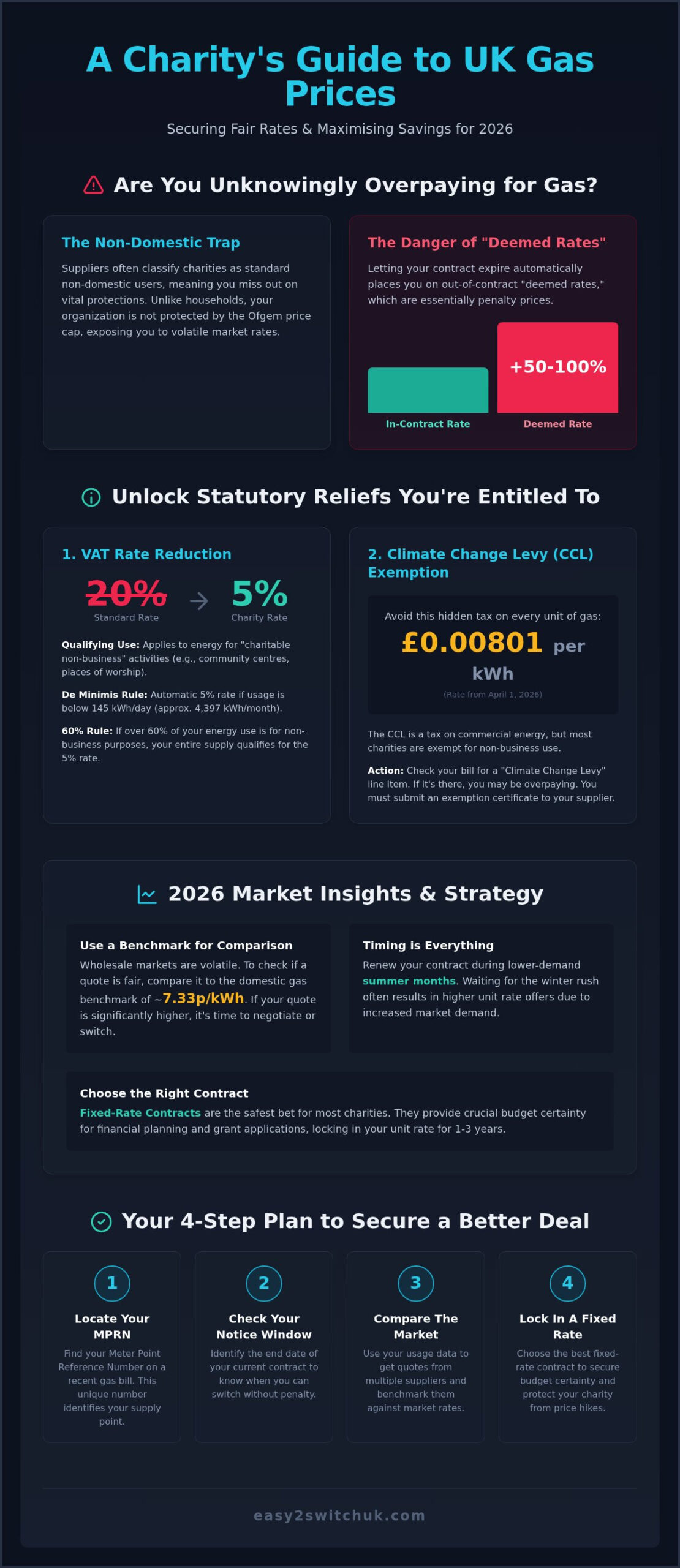
The 2026 energy market presents a complex picture for non-profits. While wholesale markets stabilized briefly, mid-year shifts have seen costs climb again. Understanding charity gas prices UK requires looking beyond headline news and focusing on the underlying wholesale drivers that dictate your monthly bills. Wholesale volatility remains a reality. As of July 2026, domestic benchmarks rose by 13%, reflecting a tightening global supply. For charities, this translates to higher contract offers. Seasonal timing is your best tool here. Renewing during the lower-demand summer months often secures a lower unit rate than waiting for the winter rush.
Wholesale Market Drivers in 2026
UK energy policy shifts in early 2026 have focused on long-term supply security. This has created a two-tier market. Organizations that act proactively are locking in rates based on healthy storage levels, while those who wait face the unpredictability of Q4 demand. Monitoring charity gas prices UK alongside current benchmarks, like the 7.33p per kWh gas rate seen in the domestic sector, helps you gauge whether your supplier’s offer is competitive. If your quote is significantly higher, it’s a clear signal to look elsewhere. Market variables are complex, but tracking these benchmarks helps you spot an unfair deal immediately.
Why Charities Fall Outside the Domestic Price Cap
Many trustees are surprised to learn that Ofgem classifies charities as non-domestic users. You don’t have the protection of a government-mandated price cap. Instead, you’re at the mercy of negotiated contracts. If you let a contract lapse, you’ll fall onto “deemed rates.” These are essentially penalty prices for being out of contract. They’re often 50% to 100% higher than standard rates. This classification makes proactive switching essential. You aren’t just another corporate entity; your funds are vital for your mission. Using 2026 average unit rates as a baseline for your negotiation ensures you aren’t subsidizing the profit margins of big suppliers.
For most non-profits, a fixed-rate contract is the safest bet. It provides the budget certainty needed for grant applications and financial planning. You’ll know exactly what you’re paying per unit for the next one to three years. Larger organizations with massive footprints might look at flexible procurement. This allows you to buy energy in stages, but it’s a high-maintenance strategy that requires constant market monitoring. Don’t forget that your bill includes more than just gas. The Climate Change Levy (CCL) adds £0.00801 to every kWh you use unless you’ve secured your exemption certificate. We’ll cover how to claim that relief in the next section.
Maximising Savings: VAT Exemptions and CCL Relief for Charities
Charities often pay more than they should because energy suppliers default new accounts to the standard 20% VAT rate. If your organisation uses gas for “charitable non-business” activities, you qualify for the reduced 5% rate. This isn’t just a minor discount; it’s a statutory right that significantly lowers charity gas prices UK. Non-business use typically includes activities provided free of charge or funded by grants, such as running a community soup kitchen or a place of worship. Even small sites benefit from the “de minimis” rule. If you use less than 145 kWh of gas per day (roughly 4,397 kWh per month), your supplier must automatically apply the 5% VAT rate and CCL exemption regardless of your activity type.
The 60% rule provides a powerful advantage for mixed-use premises. If your site’s non-business energy consumption is at least 60% of the total, the entire supply qualifies for the 5% VAT rate and full exemption from environmental taxes. You can find the precise definitions and requirements in the official government guidance. This means a community centre that hosts a small commercial cafe can still claim the full relief if the majority of the building’s floor space or usage remains dedicated to charitable work.
Understanding the Climate Change Levy (CCL)
The Climate Change Levy is a tax on commercial energy use designed to encourage efficiency, but most charities are legally exempt from paying it for non-business use. Check your latest bill for a line item labeled “CCL” or “Climate Change Levy”. As of April 1, 2026, the rate for natural gas is £0.00801 per kWh. For a medium-sized site using 150,000 kWh annually, this exemption alone saves over £1,200 every year. It’s a simple way to protect your budget from rising charity gas prices UK without changing your usage habits.
How to Claim Your VAT Reduction
Your supplier won’t automatically apply these savings for larger accounts. You must submit a VAT Declaration Certificate to confirm your eligibility. This form tells the supplier what percentage of your energy qualifies for the reduced rate. If you’ve been overpaying, you can usually backdate claims to recover overpaid tax from previous years, which often results in a significant credit on your account. The process generally involves these steps:
- Determine the percentage of your building used for non-business activities.
- Download and complete a VAT Declaration Certificate.
- Submit the form to your supplier’s dedicated tax or billing department.
- Request a written confirmation that the 5% rate has been applied.
One common pitfall is failing to update your certificate when moving suppliers or renewing a contract. Suppliers often default charities to the 20% rate because it’s the corporate standard. This is where many non-profits lose hundreds of pounds without realising it. If the paperwork feels overwhelming, our team can help you audit your current bills to ensure you aren’t leaving money on the table.
Average Charity Gas Rates per kWh in 2026
The price your organisation pays for energy depends heavily on your annual consumption. While there’s no single “charity tariff,” suppliers categorise non-profits into consumption bands that dictate the unit rates and standing charges available to you. Understanding where you sit in these bands is the first step toward benchmarking charity gas prices UK effectively. Micro-charities using under 5,000 kWh annually often pay higher unit rates but benefit from robust microbusiness protections. These include rules against back-billing beyond 12 months and clearer contract terms. For large organisations managing multiple sites, consolidated billing becomes a vital tool. It simplifies administration by aligning all your meters to a single renewal date and one monthly statement.
Standing charges have become a focal point for 2026 bill calculations. Even if your building is empty for parts of the week, you’ll still pay this daily fee for the connection to the grid. Domestic benchmarks in mid-2026 sit around 29.04p per day, but charity rates vary based on your geographic location and meter type. It’s a mistake to focus only on the unit rate while ignoring a high standing charge. This is particularly true for community centres or seasonal youth clubs where gas usage might be low, but the daily connection fee remains constant throughout the year.
Benchmarking by Consumption Level
In the 2026 market, micro-charities typically see unit rates slightly higher than the domestic price cap benchmark of 7.33p per kWh. Small to medium charities, such as those running busy community hubs or office spaces, can often negotiate lower unit rates by leveraging their higher volume. Regional network operators also influence your total cost, as distribution charges differ across the country. Be wary of “zero standing charge” tariffs. These often look attractive for buildings with low usage, but suppliers usually compensate by inflating the unit rate. For most organisations, this results in a higher total annual spend than a standard contract.
Factors That Influence Your Bespoke Quote
Your organisation’s credit score is one of the most overlooked factors in energy procurement. Suppliers use this to assess the risk of non-payment. If your charity has a thin credit history, you might be asked for a security deposit or offered less competitive rates. Your “Annual Quantity” (AQ) also plays a role. This is the estimated amount of gas your site uses each year based on historical data. If your AQ is inaccurate, you might be placed in the wrong price bracket. You should also ensure you are following the official government guidance on VAT for fuel and power to confirm you are in the correct tax category for your usage level.
Specialised tariffs are often necessary for charities with erratic usage patterns. Places of worship, for example, might use a massive amount of gas on a Sunday morning to heat a large hall but almost nothing for the rest of the week. Standard commercial contracts don’t always account for these spikes. Finding a supplier that understands these unique operational needs is just as important as finding the lowest charity gas prices UK. Getting this right ensures your budget remains predictable, even when the weather or your event schedule changes.
How to Compare and Switch Charity Gas Suppliers
Switching your provider is the most effective way to manage charity gas prices UK and ensure your funds go toward your mission rather than utility profits. The process begins with your latest annual statement. You’ll need your Meter Point Reference Number (MPRN), a unique 10-digit code that identifies your gas connection. Once you have this, pinpoint your contract end date. Most business-style contracts have a “notice window” which is often 30 to 90 days before expiry. If you miss this, you might be barred from switching or moved to expensive rates without warning.
Comparing quotes requires looking beyond the big names. Include smaller green energy specialists that often offer competitive rates for non-profits. If you use a broker, they’ll ask for a Letter of Authority (LOA). This document allows them to gather data and negotiate on your behalf. Always verify the LOA’s scope to ensure you maintain control of the final decision. Finally, when you sign the new deal, submit your VAT declaration certificate at the same time to prevent being defaulted to the 20% rate by the new supplier.
Avoiding the Rollover Trap
If your contract expires without a new agreement, your supplier will move you to “out-of-contract” or “deemed” rates. These prices can easily double your monthly expenditure. To prevent this, issue a formal notice of termination in writing as soon as your notice window opens. This simple administrative step protects your right to move and keeps charity gas prices UK manageable. Don’t wait for the supplier to contact you; they rarely offer their best deals to existing customers who stay silent.
Evaluating Supplier Service Standards
The lowest unit rate isn’t always the best value. Inaccurate billing can cause administrative nightmares that drain your staff’s time. Look for suppliers with high Trustpilot scores and dedicated charity support desks. These desks understand non-profit nuances like VAT exemptions. Additionally, prioritise suppliers that offer smart meter installations. These devices provide real-time data, ensuring you only pay for what you use and helping you spot wastage early. It’s much easier to stick to a budget when you aren’t relying on estimated bills that might be corrected months later.
Managing these steps while running a non-profit is a heavy lift. Our team handles the entire comparison and switching process for you, ensuring every tax exemption is correctly applied. You can start your free charity gas comparison today to see how much your organisation could save.
Why Easy2switch UK Ltd is the Reliable Choice for UK Charities
Managing charity gas prices UK shouldn’t take you away from your vital community work. While direct suppliers often push their own limited products, Easy2switch UK Ltd acts as an independent energy consultancy. We provide impartial access to hundreds of UK supplier offers, including unlisted rates that aren’t available on standard comparison sites. Our background in the farming sector is a key advantage. Farmers, like charities, deal with complex sites, multiple meters, and specific tax reliefs. We’ve taken that rigorous, detail-oriented approach and applied it to the non-profit world. We understand that every pound saved on standing charges or unit rates is a pound that goes directly back into your mission.
Our service is completely free for your organisation to use. Easy2switch UK Ltd is funded by supplier commissions, which means you get expert consultancy without adding another line item to your budget. We handle the entire “Done-for-You” switching process. This includes negotiating with suppliers, managing the transition paperwork, and ensuring your VAT declaration is correctly filed from day one. You won’t have to spend hours on hold or decode complex contracts; we do the heavy lifting for you. It’s a pragmatic way to ensure your energy procurement is handled by capable hands while you focus on your core objectives.
Specialised Knowledge for Non-Profits
Standard comparison tools often overlook the nuances of the charity sector. They might find a low unit rate but miss an inflated standing charge or fail to account for seasonal usage spikes. Easy2switch UK Ltd looks deeper. For instance, we’ve helped multi-site organisations consolidate their gas meters into a single, streamlined portfolio. This not only secures a lower overall rate but also drastically reduces the administrative burden on your finance team. Instead of juggling dozens of renewal dates, you get one clear, manageable energy strategy. We’re committed to finding the best individual fit for your charity’s specific needs, whether you run a single community hall or a national network of offices.
Taking Control of Your Energy Future
Securing your organisation’s financial stability starts with a clear understanding of your current spend. Easy2switch UK Ltd offers a free, no-obligation energy review that you can access via telephone or online. Our team will audit your recent bills, check for overpayments, and identify the most competitive 2026 rates. We promise a simplified, stress-free transition with zero hidden fees. It’s about giving you the tools for independence and control over your overheads. By acting now, you protect your budget from the volatility of charity gas prices UK. Ready to lower your overheads? Get a free charity gas review from Easy2switch UK Ltd and see how much you could save.
Take Control of Your Charity’s Energy Budget
Managing your utility costs is a direct way to protect your mission from market volatility. By securing the correct tax status and moving away from expensive out-of-contract rates, you can immediately redirect vital funds back into your community projects. Handling charity gas prices UK doesn’t have to be a source of administrative stress when you have a dedicated specialist managing the transition for you.
Easy2switch UK Ltd operates as an independent energy consultancy with deep expertise in the non-profit and farming sectors. Our service is completely free for your organisation, as we are funded through supplier commissions. We provide impartial, whole-of-market advice with access to hundreds of supplier offers that standard automated tools often miss. We handle the negotiations and the complex paperwork, ensuring a smooth transition that respects your time and your budget.
Secure your 2026 charity gas savings with a free Easy2switch UK Ltd review. You have worked hard to build your organisation’s impact; we are here to help you protect it with calm efficiency and reliable expertise.
Frequently Asked Questions
How much is the average charity gas price per kWh in 2026?
While there isn’t a fixed price cap for non-domestic users, rates for charity gas prices UK often track slightly above the domestic benchmark of 7.33p per kWh. Your specific quote depends on your annual consumption and geographic location. Micro-charities usually face higher unit rates but lower standing charges, while larger organisations can leverage their higher usage to negotiate more competitive volume-based discounts.
Can my charity claim back VAT on gas bills from previous years?
You can generally backdate VAT claims for up to four years if your organisation has been incorrectly charged at the standard 20% rate. To do this, you’ll need to submit a retrospective VAT Declaration Certificate to your supplier for each applicable period. This process often results in a significant credit balance on your account, providing an immediate financial boost to your charity’s cash flow.
What is the difference between a business gas contract and a charity contract?
Most energy suppliers don’t offer a specific “charity” tariff; instead, you’ll sign a standard business gas contract. The primary difference is the tax treatment rather than the contract structure itself. Charities qualify for a reduced 5% VAT rate and Climate Change Levy exemptions for non-business use. You must proactively claim these reliefs, as suppliers default most new accounts to standard commercial tax rates.
Do I need a Letter of Authority (LOA) to use an energy broker?
Yes, a Letter of Authority is a standard document that allows a broker to handle the administrative side of your procurement. It grants them permission to request your historical usage data from suppliers and negotiate new contract offers on your behalf. You always retain the final decision-making power. It’s a simple tool that removes the administrative burden from your staff while ensuring you get impartial advice.
Why are my charity gas prices higher than my home gas prices?
Your charity gas prices UK may seem higher because non-domestic supplies aren’t protected by the Ofgem domestic price cap. Business and charity contracts also include different distribution and transmission costs compared to household supplies. Furthermore, if your organisation hasn’t switched contracts in over a year, you’re likely paying “deemed rates,” which are significantly more expensive than the fixed-term deals currently available on the market.
How long does it take to switch charity gas suppliers in the UK?
The actual transfer of your supply typically takes between 15 and 21 days once you’ve signed a new agreement. However, the total timeline depends on your current contract’s notice period, which is often between 30 and 90 days. We recommend starting your comparison at least three months before your current deal expires to ensure a seamless transition and avoid any expensive out-of-contract penalty rates.
Are charities exempt from the Climate Change Levy (CCL)?
Charities are exempt from the CCL for any energy used for non-business activities, such as community outreach or grant-funded services. As of April 1, 2026, the CCL rate for natural gas is £0.00801 per kWh. This means the exemption provides a substantial saving for medium and large sites. You’ll need to submit a declaration to your supplier to confirm what percentage of your usage qualifies for this relief.
Is it better for a charity to fix gas prices for 12 or 36 months in 2026?
A 24 or 36-month fixed contract is generally the safer choice for charities seeking budget certainty in the volatile 2026 market. While a 12-month deal might sometimes offer a slightly lower initial unit rate, it leaves your organisation vulnerable to price spikes next year. Choosing a longer fixed term allows you to plan your services and manage grant funding with total confidence in your future energy overheads.
