
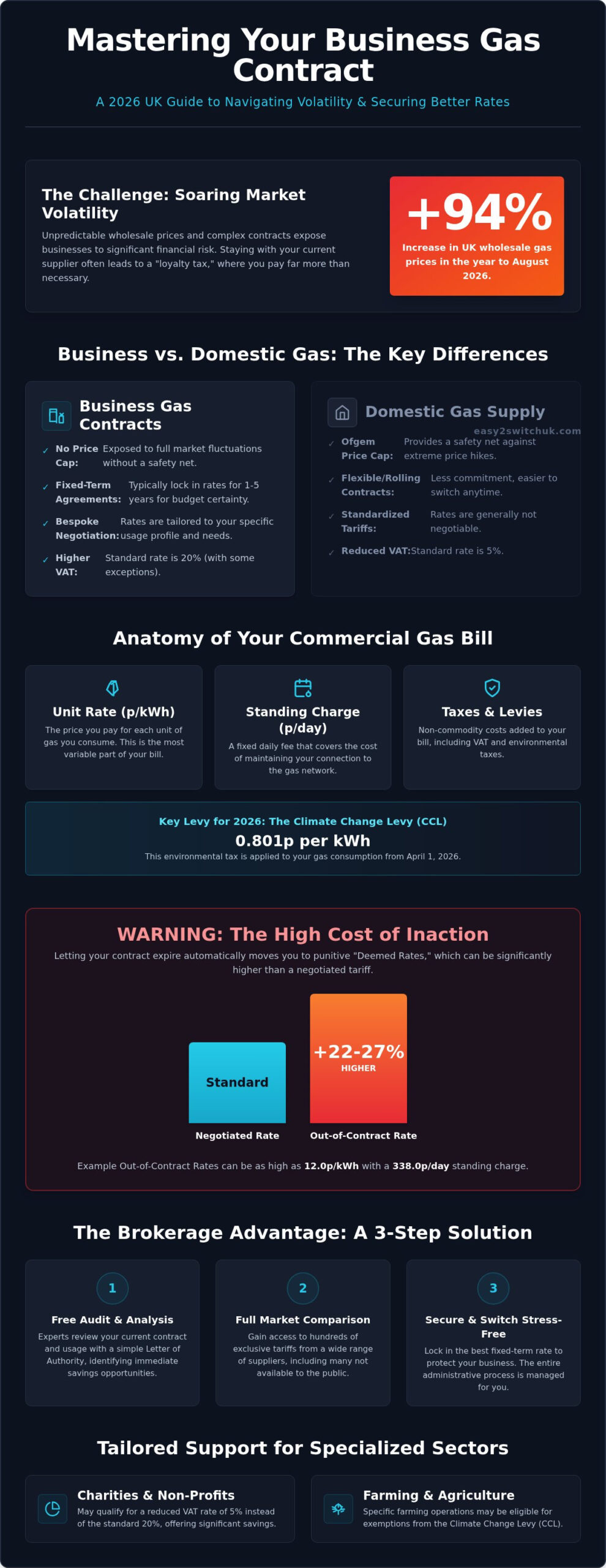
Did you know that UK wholesale gas prices rose by over 94% in the year leading up to August 2026? This level of market volatility makes securing the right business gas contracts more than just a box-ticking exercise; it’s a critical financial strategy for any enterprise. Whether you’re managing a busy commercial office or a high-demand poultry farm, the pressure of unpredictable energy bills and confusing industry jargon can be overwhelming. You likely feel that staying with your current supplier should be rewarded, yet the reality is often a “loyalty tax” that sees you paying significantly more than necessary.
We understand your time is better spent growing your business than decoding standing charges and unit rates. This guide is designed to help you master the complexities of commercial gas procurement and discover how to secure the most competitive rates for your business without the stress. We’ll explore the impact of the 0.801p per kWh Climate Change Levy, explain how to avoid punitive out-of-contract rates, and provide a clear roadmap for a done-for-you switching process that puts you back in control of your bottom line.
Key Takeaways
- Understand why business gas contracts differ from domestic deals, specifically the absence of a price cap and the requirement for bespoke negotiation.
- Learn how to deconstruct your energy bill by identifying the impact of unit rates, standing charges, and the 2026 Climate Change Levy.
- Discover the “brokerage advantage” that provides access to specialized rates and suppliers not available on the high street.
- Master a stress-free transition process by using a Letter of Authority to let experts handle the procurement complexity for you.
- Find out how specialized sectors like farming and charities can access tailored support through a completely free consultancy service.
The Fundamentals of Business Gas Supply in 2026
Business gas supply isn’t just a larger version of your home energy. It’s a bespoke commercial agreement tailored to your specific usage profile. Unlike domestic deals, business gas contracts are fixed-term commitments that provide price certainty for a set period. In 2026, being proactive is essential. With the Climate Change Levy (CCL) rising to 0.801p per kWh in April, every penny on your unit rate counts. The market moves faster now. Regulatory shifts from the 2026 Ofgem Review mean suppliers are under more scrutiny, but the responsibility to switch remains firmly with the business owner.
Commercial Gas vs. Domestic Gas: What You Need to Know
The most significant difference is the absence of the Ofgem price cap. While domestic users have a safety net, businesses are exposed to the full weight of market fluctuations. This is why many enterprises lock in rates for one to five years to ensure budget stability. You also need to consider VAT. Most businesses pay 20%, but charities and some non-profits qualify for a reduced 5% rate if they meet specific usage criteria. Getting this right from the start prevents overpayment and protects your annual cash flow.
The Impact of Market Volatility on Business Overhead
Your unit rate is heavily influenced by the National Balancing Point (NBP), which is the virtual trading hub for UK gas. Geopolitical tensions, like those seen throughout August 2026, can cause these wholesale prices to spike overnight. If you let your current deal expire without a new agreement, you’ll move to “Deemed Rates”. These are often 22% to 27% higher than negotiated tariffs. For a small business, out-of-contract rates can hit 12.0p per kWh with standing charges of 338.0p per day. Waiting until the last minute is a costly mistake that drains your capital.
A reliable specialist acts as your shield against this volatility. Energy brokers have access to hundreds of offers, including niche suppliers that don’t deal with the general public. They handle the jargon and the administrative paperwork, ensuring you don’t fall into the loyalty tax trap. By monitoring the market daily, a broker helps you strike when prices dip. This protects your margins before the next surge. It’s a pragmatic, done-for-you approach that removes the stress of procurement while keeping your overheads predictable.
Deconstructing Your Gas Bill: Unit Rates, Standing Charges, and Levies
Deciphering a commercial energy statement can feel like learning a new language. Most business gas contracts are built on a two part pricing structure: the unit rate and the standing charge. The unit rate is the price you pay for the actual gas you use, while the standing charge is a fixed daily fee that covers the cost of maintaining the physical connection to the grid. Understanding these fluctuations is easier when you consider the perspective of the UK government on gas prices, which highlights how global supply constraints drive up the base cost of your supply.
Understanding the Unit Rate and Consumption Patterns
A kilowatt-hour (kWh) is the standard unit of energy measurement for billing. High volume users, such as large manufacturing plants or commercial laundries, often have more leverage to negotiate bespoke unit rates. These rates are typically lower than those offered to micro businesses because the supplier benefits from the scale of the contract. However, your bill is only as accurate as your data. Relying on estimated readings can lead to significant catch up bills later. Providing regular meter readings ensures you only pay for what you consume, protecting your monthly cash flow from unexpected shocks.
Levies and Environmental Taxes in 2026
From April 1, 2026, the Climate Change Levy (CCL) for gas increases to 0.801p per kWh. This environmental tax is designed to encourage energy efficiency, but it adds a noticeable weight to your bottom line. Some organisations, such as charities and specific farming operations, may qualify for a reduced VAT rate of 5% instead of the standard 20%. They might also be eligible for CCL exemptions. If you are unsure whether your bill reflects the best available rates, you can request a free energy audit to identify potential savings and ensure your tax status is correctly applied.
Non-commodity costs are the “invisible” fees that suppliers rarely highlight in their marketing. These include network charges for transporting gas through the pipes and policy fees that fund renewable energy initiatives. In 2026, these charges make up a significant portion of your total bill. While you cannot negotiate the taxes or network fees themselves, optimising your business gas contracts to find a lower base unit rate is the most effective way to offset these rising external costs. We handle this complexity for you, ensuring every levy and charge is accounted for without the headache of manual calculations.
Comparing Business Gas Suppliers: Direct vs. Brokerage Models
Many business owners assume that going straight to a supplier like British Gas or E.ON is the most cost-effective route. This direct path seems simple. However, the commercial energy market is built on a different logic than domestic supply. When you deal directly, you’re limited to one set of tariffs. You also miss out on “broker-only” rates that aren’t advertised on public websites. For comprehensive advice on these structures, Ofgem’s guide to business energy provides a neutral foundation for understanding your rights as a commercial consumer.
Why ‘Direct’ Isn’t Always Cheapest
Suppliers often apply a “loyalty tax” to businesses that stay put. They count on you being too busy to shop around. Consequently, renewal quotes are frequently higher than the rates offered to new customers. Managing these business gas contracts yourself also carries a heavy time cost. You have to track termination windows, compare jargon-heavy terms, and chase multiple sales agents. It’s a fragmented process that often leads to decision fatigue and higher overheads. Without a market-wide view, it’s difficult to know if the “discount” a supplier offers is actually competitive compared to the wider market.
The Value of an Independent Energy Consultancy
Choosing a consultancy like Easy2switch UK Ltd changes the dynamic. We act as a Reliable Specialist, scanning hundreds of offers from across the national market to find the best fit for your specific usage. Our service is completely free for you to use. We’re funded by commissions from the energy suppliers, which means there are no hidden fees or invoices from our side. This transparency ensures that our focus remains entirely on your needs rather than a specific supplier’s targets.
Our approach is particularly valuable for complex sectors. Farms and charities have unique consumption patterns that require more than a one-size-fits-all solution. We manage the entire transition for you. Once you sign a Letter of Authority (LOA), we handle the negotiations and the administrative heavy lifting. This done-for-you model ensures you secure the most competitive business gas contracts without sacrificing your own productivity. It’s about taking control of your costs while letting experts handle the market volatility mentioned earlier.
A Step-by-Step Guide to Securing Your New Gas Contract
Securing competitive business gas contracts doesn’t have to be a source of administrative dread. By following a structured procurement process, you can move from market uncertainty to price stability with minimal effort. The key is timing and data accuracy. Most businesses lose money simply because they miss their renewal window or lack the specific meter data required for a precise quote. Our role is to streamline this journey, acting as the bridge between your operational needs and the complex wholesale market.
The process follows five logical stages:
- Step 1: Gather your current bill data and contract end dates to ensure we have an accurate usage profile.
- Step 2: Sign a Letter of Authority (LOA). This simple document allows us to negotiate with suppliers on your behalf without you needing to be on every call.
- Step 3: Review a tailored shortlist of quotes. We filter hundreds of offers down to the ones that actually fit your sector, whether that’s farming or a high-street charity.
- Step 4: Select your preferred tariff and sign the new agreement to lock in your rates before the market shifts again.
- Step 5: Enjoy a “Done-For-You” switch. We manage the entire handover, including the final communications with your previous supplier.
To get started on your own comparison, you can use our free switching service today and let us handle the heavy lifting.
Preparing for the Procurement Process
Before you begin, locate your Meter Point Administration Number (MPRN) on your latest bill. The MPRN is a unique 10-digit number identifying your gas supply point. Having this ready ensures that suppliers are quoting for your specific meter and not a generic estimate. You should also identify your renewal window. Missing this date often triggers expensive rollover rates, which can be significantly higher than a negotiated contract. By acting early, you stay in control of your overheads rather than being at the mercy of default supplier pricing.
Navigating the Switch Without Service Interruption
A common anxiety for business owners is the fear of a supply interruption during the transition. It’s a myth that your gas will be cut off. The switch is purely administrative; the same pipes and meters remain in place. If you have a smart meter, the process is even smoother as it ensures your final bill from the old supplier is based on actual usage rather than an estimate. Occasionally, a current supplier might object to a switch if there’s an outstanding debt or if the notice period hasn’t been met. We monitor these potential hurdles and resolve them directly, ensuring your transition remains invisible to your daily operations.
Why Easy2switch is the Strategic Choice for UK Business Gas
Choosing a partner for your energy procurement is about more than just finding a low number on a screen. It’s about finding a Reliable Specialist who understands that your focus should be on your operations, not your utility bills. We work for you, not the energy companies. This independence is what allows us to scan hundreds of business gas contracts to find the specific fit for your enterprise. Because our service is funded by supplier commissions, you never receive an invoice from us. There are no upfront fees and no hidden costs. It’s a pragmatic solution designed to give you back control in a volatile market.
Our national energy consultancy specialises in helping those who often feel overlooked by the “Big Six” suppliers. We provide a bridge between your unique commercial needs and the technical complexities of the wholesale market. By taking a proactive approach to your 2026 renewals, we help you stay ahead of price spikes and regulatory changes. This empowers you to make informed decisions without the stress of constant market monitoring. You get the benefit of expert brokerage and the peace of mind that your overheads are being managed by capable hands.
Specialist Support for the Farming Community
Modern UK agricultural sites have energy profiles that simply don’t fit into standard commercial boxes. We understand that a poultry farm or a grain drying facility has seasonal consumption peaks that can make or break an annual budget. While generic suppliers might offer a one-size-fits-all tariff, we dig deeper into your usage data. We’ve helped rural enterprises across the country navigate these complexities, often identifying savings that were previously missed due to incorrect meter classifications or overlooked exemptions. By tailoring the procurement to your specific cycles, we ensure your gas supply supports your productivity rather than hindering it.
Simple, Fast, and Stress-Free Switching
We’ve stripped away the corporate coldness often found in the energy sector. Our UK-based experts provide personalised telephone and online support, ensuring you’re never left talking to a bot. We believe in total transparency. This means we’re clear about how we’re paid and exactly what your contract terms imply. The transition is designed to be effortless. From the moment you sign the Letter of Authority to the final handover, we manage the administrative heavy lifting. This allows you to focus on growth and long-term strategy while we handle the market variables.
Ready to take control of your energy overheads? Start your free business gas review today with Easy2switch
Secure Your Financial Predictability for 2026
Taking control of your energy overheads is a vital step toward long-term business stability. We’ve explored how proactive market timing and a clear understanding of your bill’s structure can shield you from the significant premiums associated with out-of-contract rates. By moving away from the loyalty tax of direct renewals and leveraging specialist market access, you ensure your enterprise isn’t overpaying for essential utilities during periods of volatility.
Securing the most competitive business gas contracts doesn’t need to be a complex or time-consuming task. As an independent consultancy with access to hundreds of supplier offers, we provide the specialist expertise needed for sectors like farming and charities. Our service is 100% free for your business, as we’re funded entirely by supplier commissions. This means you get expert support and genuine savings without any upfront costs or hidden fees.
Ready to lock in your rates and protect your margins? Get a Free, No-Obligation Business Gas Quote. Let our team handle the administrative heavy lifting so you can focus on what you do best: growing your business. Success in 2026 starts with a smarter approach to procurement.
Frequently Asked Questions
Is it free to use a business energy broker like Easy2switch?
Our service is completely free for you to use. We receive a commission directly from the energy supplier once your new contract is live. This means there are no upfront costs, no consultation fees, and no hidden charges on your bill. Our goal is to find the best fit for your enterprise while removing the administrative burden, allowing you to benefit from expert brokerage without any direct financial outlay.
How long does it take to switch my business gas supply?
The administrative part of a switch typically takes between 15 and 30 days once your new agreement is signed. However, the actual start date of your new supply depends on the end date of your current contract and your notice period. We track these timelines for you to ensure a seamless transition. By starting the procurement process early, you can lock in rates months before your current deal officially expires.
What is a Letter of Authority (LOA) and why do I need one?
A Letter of Authority is a standard legal document that gives us permission to act on your behalf when communicating with energy suppliers. It doesn’t allow us to sign contracts without your consent. Instead, it enables us to gather your usage data, request bespoke quotes, and resolve any technical queries with your current provider. This document is essential for a done-for-you service, as it removes you from the time-consuming back-and-forth of market negotiations.
Can I switch my business gas supply if I am currently in a contract?
You can’t usually leave a fixed-term contract early without paying significant exit fees, but you can secure your next deal today. We recommend looking at business gas contracts up to six months before your current one ends. This allows you to lock in a competitive rate when market conditions are favourable. Once your existing term concludes, your supply will automatically transition to the new provider without any overlap or double billing.
Do charities get cheaper business gas rates?
Charities often pay less because they qualify for a reduced VAT rate of 5% rather than the standard 20%. Many non-profit organisations are also exempt from the Climate Change Levy (CCL). While the wholesale unit rates are similar to those for businesses, these tax reductions significantly lower the total bill. We specialise in helping charities verify their eligibility and ensure these savings are correctly applied by the supplier from day one.
What happens if I don’t renew my business gas contract on time?
If you don’t renew or switch before your contract expires, your supplier will move you onto Deemed or Out-of-Contract rates. These are significantly more expensive than negotiated tariffs, often increasing your costs by over 20%. These rates are variable, meaning they can rise without notice. To avoid this financial loyalty tax, it’s vital to have a new agreement in place before your current term ends to maintain price certainty.
Will my gas supply be interrupted during the switching process?
No, your gas supply will not be interrupted at any point. The switch is purely an administrative change between the old supplier and the new one. The physical pipes, meters, and infrastructure remain exactly as they are. You won’t experience any loss of service, and there’s no need for any work on your premises. The only difference you’ll notice is the name of the company on your bill and the improved rates you’ve secured.
How much could my business save by switching gas suppliers in 2026?
Savings vary based on your usage and your current tariff. However, businesses moving from expensive out-of-contract rates to negotiated business gas contracts often see a substantial reduction in their annual spend. For a small business, the difference between a negotiated rate and a deemed rate can be as much as 27%. By comparing hundreds of offers, we identify the specific deals that offer the best value for your consumption patterns and sector.
