
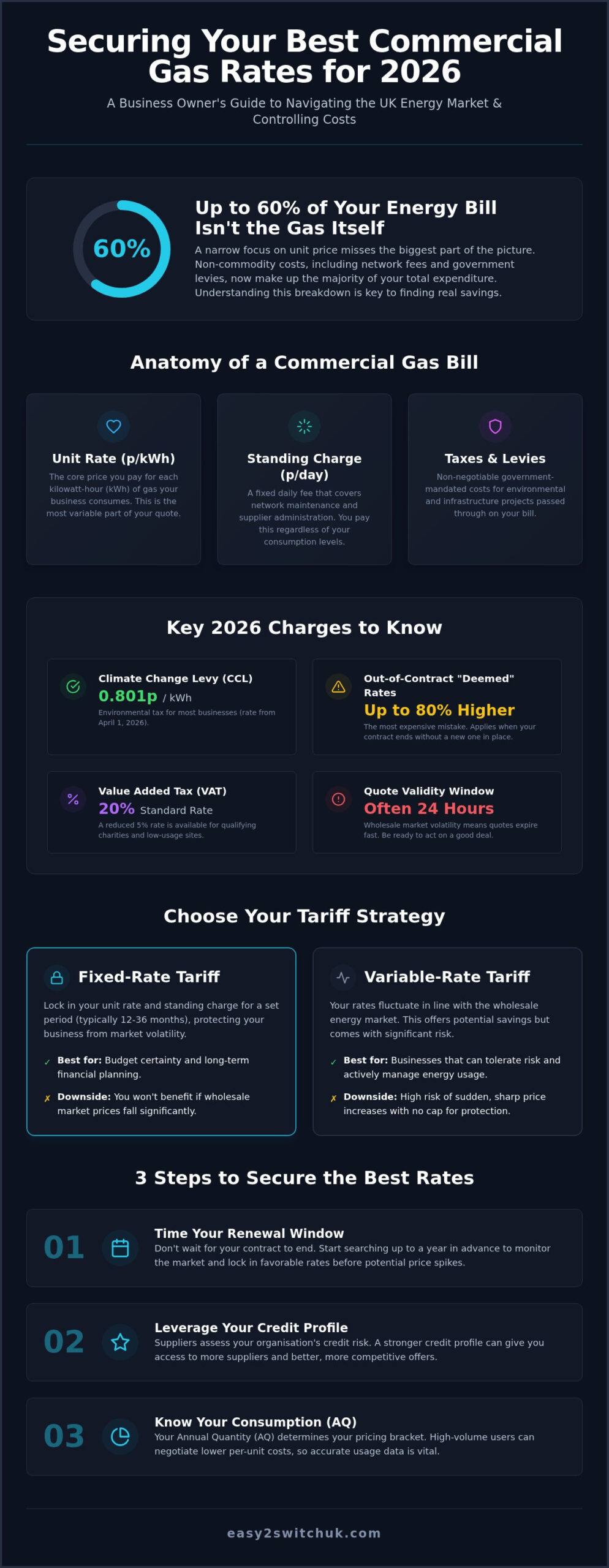
Did you know that non-commodity costs can now account for up to 60% of your total energy bill? While many UK business owners focus solely on finding the best commercial gas rates by hunting for the lowest unit price, this narrow focus often leads to unexpected costs elsewhere. We understand that managing a farm, charity, or company is demanding enough without deciphering complex contract jargon or fearing the sting of expensive out-of-contract rates. You want clarity and stability, not a second job as an energy analyst.
This guide reveals how to secure competitive gas prices for the next 12 to 36 months while avoiding the common pitfalls of the 2026 market. We will explore the impact of the 0.801p per kWh Climate Change Levy, explain how to bypass the stress of calling multiple suppliers, and provide a clear path to impartial advice. By the end of this article, you’ll have a straightforward strategy to take control of your energy procurement and protect your bottom line with confidence.
Key Takeaways
- Identify the key components of your 2026 energy bill, including how rising non-commodity costs and environmental levies impact your total expenditure.
- Master the timing of your renewal window by starting your search up to a year early to lock in the best commercial gas rates and avoid price spikes.
- Compare the benefits of fixed-rate security against variable flexibility to choose a tariff structure that provides long-term financial predictability for your business or farm.
- Learn how to leverage a stronger credit profile to gain access to more competitive offers from a wider range of UK energy suppliers.
- Discover how an independent consultancy handles the entire switching process, saving you time while ensuring you receive impartial advice tailored to your sector.
Understanding the UK Commercial Gas Market in 2026
Commercial gas rates are bespoke pricing structures offered to non-domestic users, such as farms, businesses, and charities. Unlike the standard tariffs you might see for a home, these rates are calculated based on your specific annual consumption and the perceived credit risk of your organization. In 2026, the market remains sensitive to global geopolitical tensions and shifts in UK infrastructure. For example, the Nuclear Regulated Asset Base (RAB) rate increased to £4.6830/MWh in April 2026, reflecting the ongoing investment in the national energy grid.
The most critical difference between business and domestic gas is the lack of a price cap. Businesses operate in a free market where prices are subject to direct negotiation. This means you won’t find a safety net if prices spike; instead, securing the best commercial gas rates depends on your ability to time the market and negotiate effectively. Ofgem continues to oversee supplier conduct, specifically enforcing new smart meter performance standards that went into effect on February 23, 2026, to ensure businesses receive accurate, transparent billing.
Wholesale vs. Retail: Why Your Quote Fluctuates
Suppliers don’t buy gas on the day you sign your contract. They use a process called hedging, purchasing energy months or years in advance to manage financial risk. Because the market moves constantly at the National Balancing Point (NBP), a quote you receive today might expire within 24 hours. Wholesale volatility is the primary driver of 2026 price shifts. When wholesale costs move, retail quotes follow almost instantly, making it vital to act quickly when a competitive rate appears.
Regulatory Changes Impacting Rates This Year
Several regulatory shifts are impacting your energy costs this year. From April 1, 2026, the Climate Change Levy (CCL) rate for natural gas is 0.801p per kWh, an increase aligned with the Retail Price Index. Additionally, Ofgem has introduced stricter transparency rules for energy brokers and third-party intermediaries (TPIs). These rules ensure that any commissions or fees are clearly disclosed, helping you find the best commercial gas rates without hidden costs. While standard VAT remains at 20% for most businesses, qualifying charities and low-usage sites still benefit from a reduced 5% rate.
Breaking Down the Components of a Commercial Gas Quote
When you receive a quote, it’s often more than just a single number. Understanding the breakdown is the first step toward finding the best commercial gas rates for your specific needs. Most quotes are split into two primary charges. First, the unit rate is the price you pay for every kilowatt-hour (kWh) of gas your business consumes. Second, the standing charge is a fixed daily fee. This daily cost covers the maintenance of the physical gas network and the administrative costs of supplying your premises. Even if your facility is closed for a week, you’ll still pay the standing charge.
Beyond the supplier’s own fees, your bill includes government-mandated costs that are non-negotiable. From April 1, 2026, the Climate Change Levy (CCL) for natural gas is 0.801p per kWh. This environmental tax applies to most non-domestic users to encourage energy efficiency. VAT is also a significant factor. While the standard rate is 20%, businesses with very low usage or registered charities often qualify for a reduced 5% rate. Reviewing Ofgem’s guide for businesses can help you understand your rights regarding these tax thresholds.
How Consumption Volume Affects Your Unit Price
Energy suppliers categorize businesses by their Annual Quantity (AQ). Micro-businesses often pay higher unit rates because they lack the buying power of larger corporations. In contrast, large-scale industrial users can negotiate lower per-unit costs due to their high volume of consumption. It’s helpful to remember that “best” rates are always relative to your specific annual quantity. If your consumption increases significantly, you might cross a threshold that opens up more competitive tariff options previously unavailable to your business size.
Hidden Costs to Watch Out For
The most expensive mistake a business can make is falling onto “deemed rates.” These are out-of-contract prices that apply if your current deal ends before you’ve signed a new one. They are often 80% higher than standard contracted rates. You should also consider the impact of “green” gas premiums. While many brands choose these to meet sustainability targets, they do add a surcharge to your unit rate. If you’re looking for a stress-free way to navigate these variables, our team at Easy2switch UK can help you compare transparent offers from across the market to ensure you aren’t overpaying for hidden extras.
Comparing Commercial Gas Tariffs: Which Structure Fits Your Business?
Choosing the right contract structure is just as important as finding the lowest unit price. Most organizations opt for fixed-rate tariffs, which lock in your prices for one to five years. This provides essential protection against the market spikes we’ve seen throughout 2026. While variable-rate tariffs offer the freedom to switch with shorter notice periods, they leave you exposed to wholesale price hikes. For high-volume users, flexible or pass-through contracts allow for buying gas in tranches, though this requires active market monitoring to secure the best commercial gas rates.
Environmental goals are also shaping tariff choices. Green gas tariffs utilize biomethane offsets to help businesses meet their Corporate Social Responsibility (CSR) targets. While these often carry a small premium, they provide a verifiable way to reduce your carbon footprint without changing your infrastructure. It’s a pragmatic way to align your energy procurement with your brand values while maintaining a reliable supply.
The Best Choice for UK Farmers and Agriculture
Agricultural operations face unique challenges, particularly seasonal consumption peaks. Whether you’re grain drying in late summer or heating livestock sheds through winter, your energy needs aren’t constant. Long-term fixed rates usually offer the best budget stability for these agricultural cycles, preventing price surges during your busiest months. You should also check if specific farm buildings qualify for low usage VAT discounts. If a meter serves a domestic dwelling or uses less than 145kWh per day, you could significantly lower your overheads by ensuring you’re on the correct tax tier.
Rates for Charities and Non-Profit Organisations
Charities have access to specific financial benefits that many commercial suppliers don’t automatically apply. Most non-profit organizations are eligible for a reduced 5% VAT rate on their gas bills. You’re also exempt from the Climate Change Levy if the energy is used for non-business purposes. Leveraging your status can also unlock social value schemes from certain suppliers, which are designed to support the third sector. Finding the best commercial gas rates for a charity often involves confirming these exemptions early in the quoting process to ensure your budget goes toward your core mission rather than unnecessary taxes.
Strategies for Securing the Best Commercial Gas Rates
Securing the best commercial gas rates requires a proactive strategy that begins long before your current contract expires. Most savvy operations start their market review six to twelve months in advance. This lead time is essential to avoid the trap of automatic “Rollover” contracts, which often renew at inflated prices without your consent. To get started, you’ll need a copy of a recent bill to verify your MPRN and annual consumption data. Having this information ready ensures that any quotes you receive are accurate and based on your actual usage profile.
Your business credit score plays a massive role in the offers you receive. Suppliers use this data to gauge risk; a poor score can restrict you to higher-priced tariffs or lead to demands for upfront security deposits. Improving your financial profile before you enter the market ensures you can access the most competitive deals from top-tier providers. If you want to see where your business stands, our team at Easy2switch UK Ltd can conduct a full market analysis to find the right fit for your specific profile.
Market Timing in 2026: When to Lock In
While summer was traditionally the cheapest time to buy gas, 2026 wholesale volatility has disrupted old seasonal patterns. Forward-buying is now the most effective tool for price protection. This allows you to agree on a rate today for a contract that starts in the future, effectively shielding your budget from upcoming market spikes. This strategy is particularly useful for farms or charities that need to plan their budgets years in advance. In the current economic climate, a 24-month fixed contract represents the sweet spot for balancing immediate savings with long-term financial stability.
The Broker Advantage vs. Going Direct
Negotiating directly with a single supplier often leaves you with a limited view of the market. Many of the best commercial gas rates are exclusive to intermediaries and aren’t published on public websites. Using a consultant provides a single point of contact for multiple supplier negotiations, saving you from repetitive, time-consuming sales calls. By signing a Letter of Authority (LOA), you empower a specialist to gather your data and manage the transition. This removes the administrative burden from your daily schedule while ensuring you don’t miss out on bespoke, sector-specific offers that are unavailable to the general public.
Streamlining Your Energy Procurement with Easy2switch UK Ltd
Managing energy contracts shouldn’t take time away from running your farm, charity, or company. Easy2switch UK Ltd operates as an independent energy consultancy, providing a done-for-you service that removes the administrative burden from your daily schedule. We access hundreds of supplier offers to ensure you find the best commercial gas rates without the stress of manual comparisons or endless phone calls. Our model is straightforward; we are paid via supplier commissions, which means our expert advice and switching service come at no extra cost to your organization. This transparency allows us to focus entirely on finding the right fit for your specific operational needs.
Our approach is built on pragmatic, professional authority. We understand that the energy market can feel like a maze of jargon and hidden traps. By acting as your Reliable Specialist, we demystify the procurement process and handle the complex market variables on your behalf. Whether you are a micro-business or a large-scale agricultural operation, we provide the same level of attentive, personalized support to ensure you never pay more than necessary for your energy supply. Our goal is to move you quickly from curiosity to confidence, providing a clear path to long-term savings.
Our Three-Step Process to Better Rates
- Step 1: The Review. We start with a simple analysis of your current consumption. You can send us a recent bill or call us for a quick chat. We’ll identify your current tariff structure and pinpoint exactly where you might be overpaying based on your usage history.
- Step 2: The Comparison. Once we understand your profile, we search the wider UK market. We present a clear shortlist of the best commercial gas rates currently available, explaining the pros and cons of each offer so you can make an informed decision without the sales pressure.
- Step 3: The Switch. After you choose a deal, we manage the entire transition. We handle the paperwork and communicate with the suppliers to ensure there is absolutely no interruption to your gas supply. We keep you informed throughout the process so you know exactly when your new rates take effect.
Why Thousands of UK Businesses Trust Easy2switch UK Ltd
Our team brings deep expertise to specialized sectors like agriculture and the third sector. We understand that a farm’s energy needs differ wildly from a high-street shop or a local charity. By providing impartial advice across the entire UK market, we help you navigate the 2026 market variables with calm efficiency. We don’t use hidden fees; our goal is to empower you to take control of your overheads. Take control of your energy costs with a free Easy2switch UK Ltd review and discover how simple procurement can be when handled by specialists who understand your industry.
Take Control of Your Energy Strategy in 2026
The 2026 energy landscape requires a shift from passive bill-paying to active cost management. By leveraging the timing of your renewal window and understanding the nuances of non-commodity charges, you position your organization for long-term financial resilience. Whether you’re managing seasonal agricultural peaks or a charity’s tight budget, the right tariff structure provides the stability needed to focus on your core mission rather than fluctuating overheads.
Securing the best commercial gas rates doesn’t have to be a burden on your time. At Easy2switch UK Ltd, we provide a 100% free service that gives you direct access to hundreds of supplier offers and specialized support for the UK farming sector. Our impartial advice ensures that you receive a solution tailored to your specific needs, with all the paperwork handled by our specialist team. It’s time to move from market uncertainty to total procurement confidence.
Get a Free, No-Obligation Commercial Gas Quote Today
We look forward to helping you take control of your energy future and ensuring your business thrives throughout 2026 and beyond.
Frequently Asked Questions
How do I find the cheapest commercial gas supplier for my business?
Finding the cheapest supplier involves comparing bespoke quotes from multiple providers simultaneously. Because commercial energy isn’t standardized like domestic tariffs, the lowest price for one site might be the most expensive for another based on consumption patterns. Working with an independent specialist allows you to access a wide range of offers, ensuring you secure the best commercial gas rates for your specific annual quantity and risk profile without the hassle of manual searching.
What is a business gas deemed rate and why should I avoid it?
A deemed rate is an expensive out-of-contract tariff applied when you move into a new premises without a contract or when your current deal expires without a renewal. These rates are often up to 80% higher than standard negotiated prices. You should avoid them by tracking your renewal window and signing a new agreement at least six months before your current term ends. This prevents a significant and unnecessary spike in your monthly overheads.
Can I switch my business gas supplier mid-contract?
Most commercial gas contracts are legally binding for the full term, meaning you cannot typically switch mid-contract without paying substantial termination fees. However, if you are moving premises, you can usually end the agreement through a “change of tenancy” process. It’s vital to check your specific terms for any early exit clauses. For most businesses, the focus should remain on securing the best commercial gas rates during the official renewal window to ensure a seamless transition.
Do charities get cheaper gas rates in the UK?
Charities often pay less for their energy because they qualify for a reduced VAT rate of 5% rather than the standard 20%. Additionally, many non-profit organizations are exempt from the Climate Change Levy (CCL) for their non-business activities. These tax reductions can significantly lower your total bill even if the wholesale unit rate remains similar to commercial businesses. Always ensure your supplier is aware of your charitable status to apply these savings correctly.
Will I need to have a new gas meter installed if I switch?
Switching your gas supplier is a purely administrative process that does not require any new hardware or physical changes to your pipes. Your gas will continue to be delivered through the same existing network, so there is no risk of an interruption to your supply. The only time a meter change occurs is if you specifically request a smart meter upgrade or if your current meter is found to be faulty or outdated.
How much can a business energy broker save me compared to going direct?
A business energy broker can often save you significant time and money by accessing exclusive “broker-only” tariffs that aren’t advertised to the general public. While direct quotes from big suppliers are convenient, they rarely represent the full market. Brokers negotiate with dozens of providers on your behalf, often uncovering bespoke deals for specific sectors like farming. This competition between suppliers ensures you receive the most competitive offers without having to manage multiple negotiations yourself.
Is there a cooling-off period for commercial gas contracts?
Unlike domestic energy agreements, commercial gas contracts do not typically include a cooling-off period. Once you sign a business contract or agree to it verbally over the phone, it becomes a legally binding commitment. This is why it’s essential to review the terms carefully and seek impartial advice before finalizing your deal. Taking the time to understand the fine print ensures you don’t accidentally lock your business into an unsuitable or expensive long-term arrangement.
What information do I need to provide for a commercial gas quote?
To receive an accurate quote, you need to provide your business name, the full supply address, and your Meter Point Reference Number (MPRN). Providing a copy of a recent bill is the most efficient method, as it contains your annual consumption data and current contract end date. This information allows suppliers to calculate a bespoke rate based on your actual usage history, ensuring the quote you receive is both realistic and tailored to your operational needs.
