
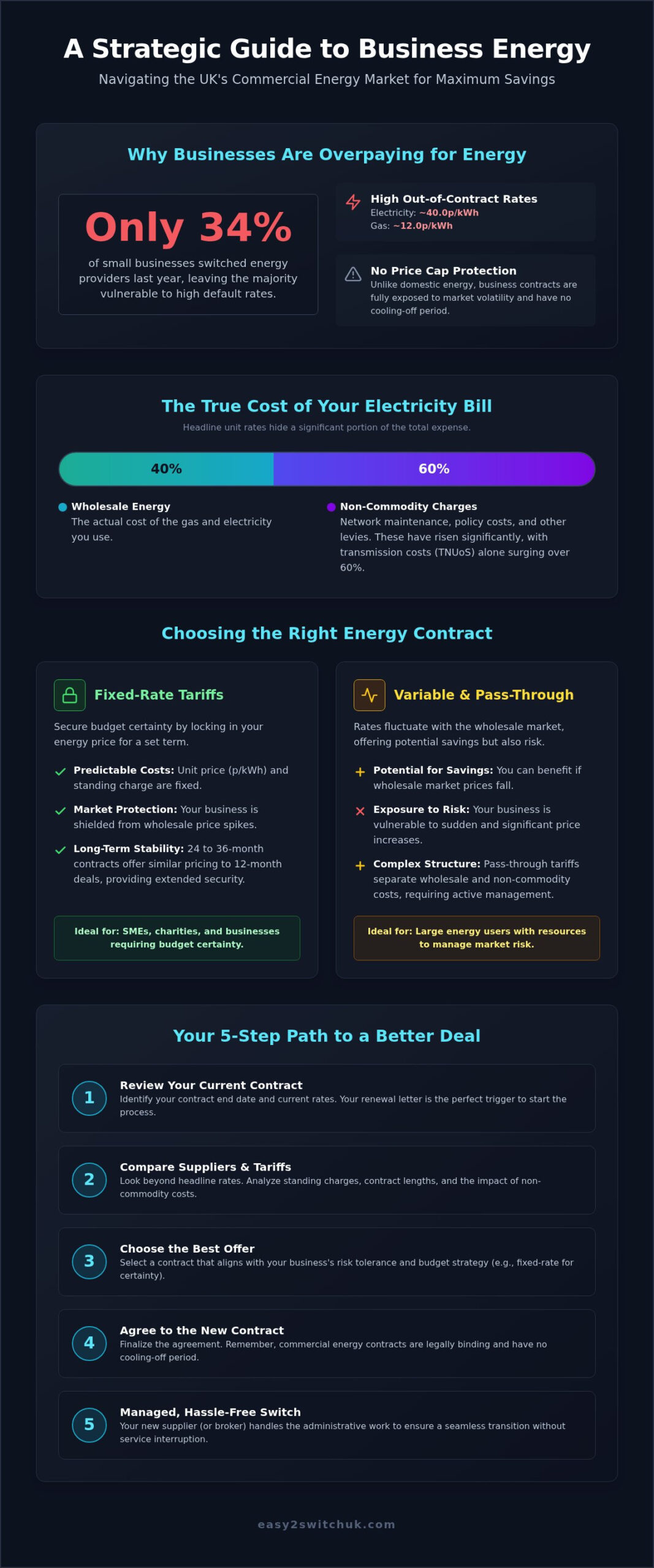
Did you know that only 34% of small businesses switched their energy provider last year, even as wholesale costs shifted and new regulations took hold? It’s a startling figure when you consider that non-commodity charges, including network and policy costs, now account for over 60% of your total electricity bill. We understand that for most business owners and farmers, the prospect of digging through volatile market data is exhausting. It’s easy to feel overwhelmed when you try to compare business gas and electricity suppliers, especially when faced with complex jargon like KVA or the fear of hidden broker fees.
You deserve a strategy that prioritizes your bottom line without demanding hours of your time. This guide will teach you how to secure the most cost-effective contracts for your specific needs by identifying the best deals currently available in the UK market. We’ll explore the impact of the October 2026 VAT removal on electricity, the 60% rise in TNUoS charges seen earlier this year, and how to lock in budget certainty with fixed rates. By the end, you’ll have a clear, managed path to lower annual expenditure and a stress-free transition that puts you back in charge of your energy costs.
Key Takeaways
- Move beyond basic price checks and treat energy procurement as a strategic tool to protect your operation from expensive default rates.
- Discover how to compare business gas and electricity suppliers effectively by evaluating the long-term benefits of fixed-rate contracts versus flexible procurement.
- Learn to identify the “true cost” of your energy by calculating the impact of standing charges and non-commodity costs that headline rates often hide.
- Streamline your transition with a managed five-step switching process that handles the administrative burden and ensures a hassle-free transition.
- Understand why a specialist broker with deep experience in the UK farming and charity sectors can unlock better value than generic comparison websites.
Why Comparing Business Gas and Electricity Suppliers is Essential in 2026
Treating your energy bill as a fixed overhead is a costly mistake in the current economic climate. By August 2026, renewed geopolitical tensions have once again pushed wholesale prices upward. This makes it vital to compare business gas and electricity suppliers as a strategic procurement exercise rather than a simple administrative chore. For many small and medium enterprises (SMEs), standard variable rates have become a financial trap. If your contract has expired, you’re likely paying “deemed rates,” which are significantly higher than negotiated terms. As of August 2026, out-of-contract electricity rates have reached approximately 40.0p per kWh, while gas has climbed to 12.0p per kWh. Taking control of these costs is one of the most effective ways to protect your operational margins.
The Difference Between Domestic and Commercial Energy
Business energy operates under entirely different rules than household supply. Unlike domestic energy, business contracts don’t benefit from the Ofgem price cap. While the domestic cap rose by 4% in late 2026, businesses remain fully exposed to the volatility of the wholesale market. It’s also important to remember that commercial agreements are legally binding. There is no cooling-off period once you agree to a deal, even if the agreement is made verbally. While the market was historically dominated by the Big Six energy suppliers, the 2026 landscape offers a wider range of specialists who tailor contracts to your specific consumption volume and industry profile.
When is the Right Time to Start Comparing?
You don’t have to wait for your current deal to expire to find a better rate. Waiting until the last minute is a common error that often leads to higher costs or forced rollovers. Most suppliers allow for “forward-buying,” where you secure next year’s rates at today’s prices. This strategy is particularly useful in 2026, especially since transmission costs (TNUoS) surged by over 60% in April. By starting the process early, you gain the leverage needed to compare business gas and electricity suppliers and find a fit that offers budget certainty. Your renewal letter should be the immediate trigger to start looking for a more competitive arrangement.
Understanding the Different Types of Business Energy Contracts
Choosing the right contract is just as important as the supplier you pick. In 2026, renewable energy sources provide over half of the UK’s electricity generation. This shift has made green energy tariffs much more competitive. Many suppliers now offer 100% renewable-backed options that allow your business to meet sustainability targets without a significant price hike. If you’ve recently moved into a new site, be wary of “deemed” or bridge contracts. These are default arrangements that apply when no formal agreement is in place. They’re incredibly expensive and can drain your budget quickly. Taking the time to compare business gas and electricity suppliers before you move ensures you aren’t stuck on these high-cost rates from day one.
Fixed-Rate Tariffs: Securing Budget Certainty
Small businesses and charities usually prefer fixed-rate tariffs for their predictability. In this setup, the unit price per kWh and the daily standing charge stay the same for the duration of your contract. Whether you choose a one, two, or three-year term, your rate won’t change even if the wholesale market becomes volatile. Interestingly, August 2026 data shows that 24 to 36-month contracts are priced very similarly to 12-month deals. This offers a rare chance to secure long-term price stability during a period of geopolitical uncertainty. It’s a pragmatic way to take control of your overheads. Many local firms work with a specialist to find these multi-year deals before market conditions shift again.
Variable and Pass-Through Contracts
Variable-rate contracts move up and down with the wholesale market. They offer flexibility because they usually don’t have long end dates, but they leave you exposed to sudden price spikes. Pass-through contracts are a more complex version of this. They separate the wholesale cost of energy from the non-commodity charges, such as network and policy costs. In 2026, these non-commodity charges make up around 60-64% of a typical business electricity bill. For very large energy users, flexible procurement allows them to buy energy in blocks, which can save money if managed by experts. However, for most, the risk of a sudden market surge is too high. Ofgem’s energy advice for businesses highlights that you must check which specific costs are “passed through” to avoid unexpected bill increases. When you compare business gas and electricity suppliers, always ask for a full breakdown of these potential variables to ensure there are no hidden surprises.
The True Cost of Business Energy: Beyond the Unit Rate
Focusing solely on the unit rate is a common pitfall. While a low pence-per-kilowatt-hour (p/kWh) figure looks attractive, it’s only one part of your total expenditure. When you compare business gas and electricity suppliers, you’re actually looking at a multi-layered pricing structure. A standard bill consists of the unit rate, a daily standing charge, and various taxes and levies. For industrial sites and farms, “agreed capacity” or KVA charges also play a major role. Understanding how these elements interact is the only way to find a deal that truly fits your operational budget.
VAT and CCL: Are You Paying Too Much?
Taxation often surprises business owners who aren’t prepared for the extra costs. Most businesses pay a standard 20% VAT, but many charities and small operations qualify for a reduced 5% rate. It’s vital to check your status. From October 1, 2026, to March 31, 2027, VAT is removed entirely from electricity bills for certain small businesses. Gas VAT remains at 5% during this period. Beyond VAT, the Climate Change Levy (CCL) is a tax on energy delivered to non-domestic users. If you’re a charity trustee, you should ensure you’ve submitted the correct certificates to your supplier to claim your exemptions. Knowing how to set up a business energy contract properly includes verifying these tax statuses from the start.
Standing Charges and Metering Types
The standing charge is a fixed daily fee that covers the maintenance of the national grid and the cost of your connection. As of August 2026, these charges vary significantly based on your consumption profile. A micro business might pay around 54.9p per day for electricity, while a large business could face 148.0p or more. If your site uses a Half-Hourly (HH) meter, your data is sent to the supplier every 30 minutes. This allows for more accurate billing but requires a more detailed comparison process. For farms or industrial units with high-power machinery, you also need to monitor your KVA. This is the amount of power the network reserves for your site. If you exceed this limit, you’ll face heavy penalties. Conversely, if your agreed capacity is too high, you’re paying for power you don’t use. A consolidated strategy is essential if you manage multiple meters across different locations. When you compare business gas and electricity suppliers, always ask for a breakdown of these fixed costs to avoid nasty surprises on your first bill.
How to Successfully Switch Your Business Energy Supplier
Switching doesn’t have to be a burden on your schedule. While the UK energy market feels complex, the actual path to a new contract follows a logical, five-step journey designed to protect your budget. A managed switch removes the administrative heavy lifting, allowing you to focus on running your farm or business while experts handle the technicalities. The process typically looks like this:
- Data Gathering: Collecting your recent bills and meter numbers.
- Comparison: Checking hundreds of supplier offers to find the best fit.
- LOA: Authorizing a specialist to act on your behalf.
- Validation: Confirming contract details and passing credit checks.
- Live Date: The seamless transition to your new, lower rate.
In the current 2026 regulations, the “Termination Notice” remains a mandatory step for most fixed-term contracts. You must notify your provider within the specific window mentioned in your contract terms to prevent an automatic “rollover” onto expensive variable rates. If your losing supplier raises an objection, which usually happens due to a technical error or an outstanding balance, a specialist can step in to resolve the dispute quickly. This “done-for-you” approach is particularly valuable for busy farmers and charity trustees who cannot afford to spend hours on hold with energy companies.
Gathering Your Data: What You Need to Start
To get an accurate quote when you compare business gas and electricity suppliers, you need specific data from a recent bill. Locate your Meter Point Administration Number (MPAN) for electricity or your Meter Point Reference Number (MPRN) for gas. These unique identifiers ensure you’re quoted for the correct connection. You also need your annual consumption in kWh. This data is vital because suppliers offer different rates based on how much energy you use. If you’ve just moved into a new site, you can find your current supplier by checking the meter serial number or contacting the local network operator.
The Role of the Letter of Authority (LOA)
A Letter of Authority (LOA) is a document that empowers a broker to act on your behalf. A “Level 1” LOA is the industry standard for information gathering. It allows a specialist to request your usage data and current contract details from suppliers. It does not permit them to sign contracts or make financial decisions without your express consent. You retain final approval on every deal, ensuring you stay in control of your procurement. This system allows you to compare business gas and electricity suppliers efficiently while a professional handles the technical queries. You can start your managed switch today to simplify your energy management.
Navigating the Market with a Specialist Energy Broker
Generic comparison sites often treat a high-street coffee shop the same as a large-scale dairy farm. This approach fails to capture the full picture. Algorithms are excellent for speed, but they lack the industry-specific knowledge required to truly compare business gas and electricity suppliers for complex operations. A specialist consultancy acts as a bridge between your unique consumption needs and the hundreds of available supplier offers. Instead of a one-size-fits-all digital quote, you receive a human-led analysis that considers your operational reality and long-term goals.
Specialist Support for Farms and Charities
Farms don’t follow a standard 9-to-5 energy profile. Your energy use often involves significant seasonal peaks, such as grain drying in late summer or the constant, heavy demands of milking parlors and refrigeration. A specialist who understands “farm energy” knows how to match these specific patterns with a tariff that won’t penalize you for high-usage periods. Similarly, charities have unique opportunities to leverage their status for better procurement terms and tax exemptions. Having a partner who understands the regional industry landscape ensures you aren’t leaving money on the table or missing out on sector-specific benefits. This personalized attention creates a more reliable fit than any automated bot can provide.
Transparency: How Our Free Service Works
You might feel cautious about hidden fees when dealing with energy brokers. We believe in complete transparency to alleviate that anxiety. Our service is entirely free for the end-user. You won’t receive a bill from us for the comparison or the managed switching process. Instead, we are funded by supplier commissions. This commission is paid by the supplier and built into the unit rate of the contract you choose. It’s a pragmatic model that ensures we only succeed when we find a deal that works for you and you successfully transition to your new supplier. This alignment of interests focuses on finding the best individual fit rather than just a quick transaction.
By choosing a specialist over a generic platform, you’re doing more than just cutting costs. You’re taking control of your energy future. This transition is a tool for independence, moving you from a passive consumer to an empowered procurer. In a 2026 market where volatility is a constant factor, having a reliable specialist manage the variables gives you the confidence to focus on your core work. When you compare business gas and electricity suppliers through a consultancy like Easy2switch UK Ltd, you gain an advocate who handles the complexity so you can enjoy the savings.
Secure Your Energy Future Today
Managing your overheads in 2026 requires more than just a quick glance at a bill. It’s about recognizing that energy procurement is a strategic tool for your business’s independence. By now, you understand that the true cost of power involves a mix of unit rates, standing charges, and complex levies like the CCL. Whether you’re running a busy dairy farm or a local charity, the right contract provides the budget certainty you need to thrive despite market volatility.
When you choose to compare business gas and electricity suppliers through a specialist partner, you move away from generic algorithms and toward tailored solutions. We’ve simplified the entire process, offering a managed switching process from start to finish with no hidden fees. As a dedicated energy consultancy for the UK farming industry, we provide access to hundreds of competitive supplier offers to ensure you find the perfect fit for your consumption profile.
Take control of your energy costs with a free, impartial review from Easy2switch. It’s time to stop overpaying and start protecting your bottom line with professional support you can trust.
Frequently Asked Questions
How long does it take to switch business energy suppliers in 2026?
It typically takes between 15 and 30 days to complete a switch once you choose a new provider. The actual timeline depends on your current contract’s notice period and how quickly the new supplier validates your data. Since there’s no physical interruption to your supply, the transition is seamless. A specialist can track this progress for you, ensuring the move happens exactly when your old contract ends to avoid expensive bridge rates.
Is there a cooling-off period for business energy contracts?
No, business energy contracts don’t have a cooling-off period. Unlike domestic agreements, a commercial contract is legally binding the moment you agree to the terms, whether that’s in writing or over the phone. This is why it’s so important to compare business gas and electricity suppliers carefully before committing. You should always double-check the unit rates and standing charges before giving your final approval to any deal.
Can I switch energy suppliers if I am in a fixed-term contract?
You can only switch without penalty once you enter your “renewal window,” which is usually six months before your current deal expires. While you can sign a new contract earlier through forward-buying, it won’t go live until your existing term ends. If you try to leave earlier, your current supplier will likely charge significant exit fees. We recommend starting your search as soon as you receive your renewal letter to secure the best future rates.
What happens if my business energy supplier goes bust?
Your energy supply won’t be interrupted if a supplier fails. Ofgem will automatically move you to a “Supplier of Last Resort” to ensure your business stays powered. While your lights stay on, you’ll likely be placed on a more expensive deemed tariff. This is a critical time to compare business gas and electricity suppliers again, as you’re free to switch away from the new supplier immediately without paying exit fees.
How much can a business energy broker typically save me?
Savings vary depending on your annual consumption and current tariff. Most businesses find the biggest value in avoiding “out-of-contract” rates, which can be double the cost of a negotiated deal. A broker accesses internal “wholesale-plus” rates that aren’t available on public comparison websites. For a medium-sized farm or charity, these bespoke negotiations often lead to thousands of pounds in avoided costs over a multi-year contract period.
Do I need to install a smart meter to switch suppliers?
You don’t strictly need a smart meter to switch, but they’re becoming increasingly helpful in the 2026 market. Many of the most competitive “green” or “time-of-use” tariffs require a smart meter to provide accurate, real-time data to the supplier. If you don’t have one, you can still switch using traditional meter readings. However, installing one can help you take control of your usage and eliminate the stress of estimated bills.
What is the Climate Change Levy and does my business have to pay it?
The Climate Change Levy (CCL) is a government tax on energy used by non-domestic customers to encourage higher energy efficiency. Most businesses pay this at a standard rate per kWh, but certain sectors can claim exemptions. Charities and some agricultural businesses often qualify for a 100% exemption or a significantly reduced rate. It’s vital to check your eligibility and submit the correct VAT and CCL certificates to your supplier to avoid unnecessary charges.
How do I compare energy prices for multiple business sites?
Multi-site businesses should use a consolidated comparison strategy rather than looking at each meter individually. By grouping your sites into a single portfolio, you gain more bargaining power with suppliers. This often leads to a single end date for all contracts, which simplifies your future renewals. A specialist can manage this complexity, ensuring every barn, office, or shop in your organization is on the most efficient tariff possible.
