
Solar isn’t automatically the cheapest way to run an irrigation pump. Your irrigation and water pumping electricity costs depend on the energy the pump uses and your electricity rate; solar can offset energy expenses over time, but it involves an upfront investment. Whether it makes sense depends on how much power your system needs, when it runs and how well solar generation fits that demand.
It’s understandable to focus on the electricity bill when pumping is essential to keeping crops watered. To estimate the cost, multiply the pump’s electricity use in kilowatt-hours by your unit rate. This gives you a more useful starting point than a broad average.
This guide explains how to estimate daily and annual pumping costs, what affects energy use, and practical ways to reduce it. It also covers how to assess solar for your farm, weighing potential energy savings against the investment and operating needs of your irrigation system.
Key Takeaways
- Compare pump power use with the water flow and pressure delivered to spot performance issues and assess solar suitability.
- Use Total Dynamic Head and Overall Pumping Efficiency to understand how lift, pressure and pump performance affect energy demand.
- Estimate annual electricity spending by combining your unit rate, energy used per volume of water and yearly water pumped.
- Break pumping use down by day to see how operating patterns affect farm costs and whether solar could offset some energy demand.
Does solar make sense for agricultural irrigation?
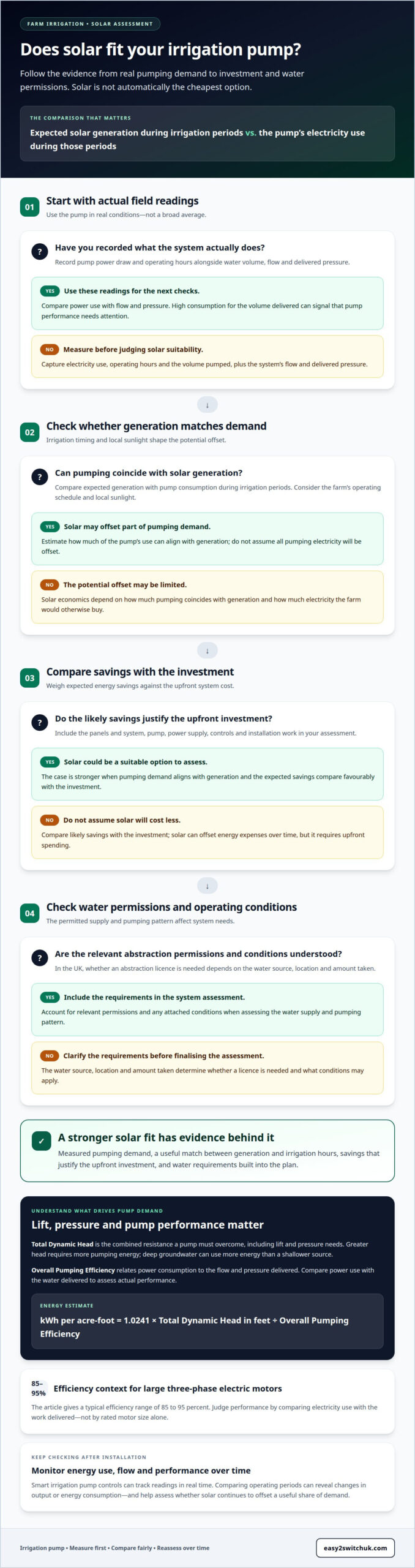
Solar may make sense when generation aligns with your irrigation system’s pumping demand. It can offset energy costs over time, particularly where sunlight is abundant, but the panels and system require upfront investment. Compare likely savings with that investment rather than assuming solar will always cost less than grid electricity.
Measure the pump’s electricity use, water flow and delivered pressure while it operates. Record its power draw and operating hours alongside the volume pumped. These readings show how much energy the system uses to deliver water in actual field conditions. Compare power use with flow and pressure: high consumption for the volume delivered can signal that pump performance needs attention.
There is no single electricity-use figure per megalitre that applies to every UK farm. Energy demand depends on factors such as pumping head, pressure and pump efficiency. To calculate your own figure, record the electricity used to pump a measured volume, then compare the kilowatt-hours with the megalitres delivered.
In the UK, whether you need an abstraction licence depends on the water source, location and amount taken. Irrigation must comply with the relevant permissions and any conditions attached to the abstraction. Include these requirements when assessing a solar-powered pump, because the permitted water supply and pumping pattern shape the system’s needs.
Solar economics depend on how much pumping can coincide with solar generation and how much electricity the farm would otherwise buy. Compare expected generation with the pump’s consumption during irrigation periods, then account for the upfront investment. A solar-powered irrigation pump may suit a farm where the operating schedule and local sunlight align with its output.
Monitor performance over time, not just at installation. Smart irrigation pump controls can track energy use, flow rates and pump performance in real time. Compare readings across operating periods to spot changes in output or energy consumption. This helps you assess whether the system remains suitable and whether solar could offset a useful share of pumping demand.
How can I reduce the energy consumption of an irrigation system?
Start by assessing the work needed to move water and how efficiently the irrigation pump delivers it. Total Dynamic Head and Overall Pumping Efficiency help explain where energy demand comes from.
Total Dynamic Head and Pumping Efficiency
Total Dynamic Head is the combined resistance a pump must overcome to deliver water, including lift and pressure needs. Greater head requires more pumping energy, so deep groundwater can use more energy than a shallower source. The estimate is kWh per acre-foot = 1.0241 × Total Dynamic Head in feet ÷ Overall Pumping Efficiency. Overall Pumping Efficiency relates power consumption to the flow and pressure delivered. Compare those values to see how head and pump performance affect demand.
Pump Sizing, Efficiency, and Maintenance
A correctly sized pump supplies the field’s required flow and pressure without unnecessary over-pumping. Oversizing can waste energy and water; undersizing may fail to meet irrigation demand. Check pump wear regularly and recalibrate when needed, since maintenance affects performance. For large three-phase electric motors, typical efficiency ranges from 85 to 95 percent. Compare the motor’s electricity use with the work it delivers, rather than judging efficiency from its rated size alone.
The irrigation method matters too. Replacing flood irrigation with drip or pivot systems can reduce water use and the volume the pump needs to move. Match the method to the crop and field layout, then assess whether lower water demand changes pumping hours or pressure requirements. Those changes determine whether the pump uses less energy.
For fuel-powered systems, compare fuel consumption with useful pumping output under the farm’s actual operating conditions. Engine condition, load and maintenance influence how much fuel is needed to deliver water. Track consumption alongside operating hours and water output; this helps distinguish engine inefficiency from changes in irrigation demand. For electric pumps, comparing supply contracts can also help manage the electricity-rate part of running costs through farm electricity contract comparisons.
How do I calculate the electricity cost of pumping water for irrigation?
To estimate annual costs, multiply your electricity price per kilowatt-hour by the energy used per acre-foot and the acre-feet delivered each year. This brings the farm’s rate, pumping demand and annual irrigation volume into one calculation. For a daily estimate, multiply that day’s electricity use by the applicable unit rate.
Mains water, boreholes and river abstraction affect costs differently. Mains supply costs depend on the supplier’s charges and volume used; borehole pumping energy depends partly on the lift from the water table. River pumping depends on the lift and conveyance needed to move water to fields. Separate water-supply charges from pump energy to compare options fairly.
There is no single UK grant amount to include in every agricultural pump calculation. Support depends on the programme, project and eligibility criteria, so assess it alongside equipment investment and expected energy savings.
For grid-connected electric pumps, calculate electricity costs directly from the unit rate. For diesel pumps, track fuel consumed during operation and include engine servicing and repairs in the running-cost comparison. A solar-powered pump can reduce reliance on purchased electricity, but its economics depend on whether generation matches irrigation demand and justifies the upfront investment.
Compare options using the same pumping volume and operating period. Include the pump, power supply, controls and installation work in your investment assessment. For solar, match panel output and pump requirements to the flow and pressure the agricultural system needs. Financing affects cash flow and total project cost, so include its terms when assessing whether renewable power is economic.
Operation and maintenance also affect the annual total. Record electricity or fuel use, operating hours, water delivered and repair costs in the same log. For an electric motor, the typical annual repair and maintenance factor is 2% of initial cost. Review that allowance against your actual maintenance records, then compare the resulting yearly total across grid, diesel and solar options.
Daily pumping costs for an irrigated farm
Calculate daily electricity costs by multiplying the pump’s energy use in kilowatt-hours by that day’s unit rate. If a meter records the pump separately, subtract its starting reading from its ending reading, then multiply the difference by the applicable rate. Include standing charges separately if you want to estimate the full electricity bill, rather than pumping costs alone.
There isn’t one typical UK pumping cost per hectare for every crop. Daily and seasonal costs depend on crop water demand, irrigation depth, water source, pumping lift, system efficiency and electricity tariff. Compare fields over the same period and area, recording both energy use and water delivered. This makes comparisons between crops more useful than a broad average.
For example, a daily farm log can record the date, pump meter readings, operating hours, water volume and unit rate. Calculate each day’s energy cost from the meter difference and rate, then divide by the hectares irrigated to find a per-hectare figure. Keep calculations separate for each pump or field when operating conditions differ.
Farmers can compare daily use with their supply tariff too. Under a Time of Use schedule, avoiding peak hours can reduce electricity costs. Check that changing pumping times works with crop water needs and the available water supply. Record the new operating period, then compare its energy use and charge with the previous pattern.
Review daily records across the irrigation period to identify high-use days and potential savings. A rise in energy for similar water delivery may point to changed pumping conditions or reduced pump performance. Compare meter use, flow and operating hours before changing schedules. To assess whether your electricity contract fits farm demand, explore farm electricity contract options.
Easy2switch UK: Farm Energy Brokerage
Easy2switch UK Ltd helps farms compare electricity and gas contracts through its Farm Energy Brokerage. Once you’ve estimated pumping demand and reviewed your operating patterns, comparing supply contracts can help you assess whether your current arrangement fits your farm’s energy use. Easy2switch UK Ltd searches supplier offers and manages the switching process for you. It earns commission from the energy supplier you choose to switch to, so you can factor that into your decision.
This is a practical next step if electricity supply is a major part of your irrigation costs and you’re ready to compare contract options. The same brokerage also supports businesses and charities through Business Energy Brokerage and Charity Energy Brokerage.
To discuss your farm’s energy contract options, visit easy2switchuk.com.
Make your next energy decision with confidence
Turn your irrigation schedule into a clearer picture of farm energy demand. Record pumping periods and electricity use, then use this information when reviewing your supply contract. It gives the discussion a practical starting point based on how your farm operates, rather than a generic estimate.
Managing irrigation and water pumping electricity costs also means considering how energy choices fit the wider farm, not just one pump. A contract review can help you assess whether your electricity arrangements still suit your operating needs as those needs change.
Easy2switch UK Ltd can help make that review simpler by comparing supplier offers and managing the switching process. If you’re ready to explore your options, contact Easy2switch UK Ltd. A clearer view of your energy arrangements is a practical step towards taking greater control of farm costs.
Frequently Asked Questions
How do I calculate the energy cost of running an irrigation pump?
Multiply the pump’s electricity use in kilowatt-hours by the unit rate on your bill. To estimate annual irrigation and water pumping electricity costs, use total yearly pump consumption, not the whole farm’s meter reading. If the pump has a dedicated meter, compare readings across its operating period. Otherwise, isolate pump use with suitable monitoring. Add standing charges separately when estimating the full bill.
How do I know if my irrigation pump is using too much electricity?
A pump may be using too much electricity if energy use rises while delivered water, pressure and operating conditions remain similar. Track kilowatt-hours, flow and pump hours together, then compare like-for-like runs. A worn pump, leak, blockage or poor calibration can increase consumption or reduce useful output. The key sign is more energy for the same irrigation result, not a universal threshold.
How does smart irrigation technology help reduce energy costs?
Smart pump controls can show energy use, flow rates and pump performance in real time, helping you spot changes during operation. Some systems can adjust pump speeds during off-peak hours where your tariff makes this useful. Controls can also alert users to clogs or leaks and enable automatic shutdowns. These features help match pump operation to field demand and reduce avoidable running.
What Drives the Costs of Pumping Water?
The main cost drivers are the electricity rate, energy use, pumping hours and the work needed to move water. Greater lift or pressure demand increases the load; a less efficient pump may need more energy for the same output. Water source, pipe layout and irrigation method also affect pumping requirements. Compare these factors with the volume delivered to understand why costs differ between fields.
What is Overall Pumping Efficiency (OPE) and why does it matter?
Overall Pumping Efficiency measures pump performance by relating energy use to the flow and pressure delivered. It matters because electricity use alone doesn’t show how effectively a pump moves water. Compare power draw with output under similar operating conditions. If energy use rises while flow or pressure falls, the pump may need maintenance, recalibration or a closer performance assessment.
What is the average UK business electricity price per kWh for farms?
A farm’s electricity price per kilowatt-hour depends on its contract’s unit rate and tariff structure, so no single rate applies to every business. Read the unit rate on your bill and note whether prices vary by time of use. Match pumping periods to the relevant rate periods, and keep standing charges separate when comparing energy costs across contracts.
