
A half-hourly meter can make the pattern of your electricity use as important as the total. For UK businesses, half-hourly metering is compulsory when maximum demand reaches 100 kW or higher during any half-hour period. The meter records consumption every 30 minutes, producing 48 readings a day, which help shape how half-hourly electricity contracts in the UK account for usage.
It’s easy to focus on the unit rate when comparing business electricity deals, but other contract costs and terms can matter just as much. Understanding how your meter records consumption is a practical first step in deciding whether half-hourly electricity contracts in the UK suit your site.
This guide explains how meter readings feed into settlement, what maximum demand and capacity charges mean, and how business tariff options can affect your contract. It also covers what to compare so you can make a more informed decision about your electricity supply.
Key Takeaways
- Use half-hourly consumption data to understand when your business uses electricity and how that pattern affects contract costs.
- Compare your site’s agreed capacity with its peak demand to understand capacity charges and avoid excess-capacity penalties.
- Learn how half-hourly settlement changes the way electricity use is allocated and billed across the market.
- Compare tariff structures and contract terms against your operating patterns before choosing a business electricity deal.
What is a half-hourly meter?
A half-hourly electricity meter records a business site’s consumption every 30 minutes, creating 48 readings a day. These readings show when energy is used, not just the total consumed.
Identifying Half-Hourly Metering
Check the electricity bill for half-hourly consumption data or references to half-hourly metering. You can also inspect the site’s MPAN: the top-row digits beginning with 00 indicate a half-hourly supply. Use the bill and MPAN together to identify how the site is registered.
For UK businesses, half-hourly metering is compulsory when maximum demand reaches 100 kW or higher during any half-hour period. This threshold concerns peak demand, so a site’s total monthly energy use alone won’t show whether the rule applies.
Business Usage and Meter Charges
Half-hourly readings give suppliers a detailed picture of when and how much electricity a business uses. Bills can reflect consumption timing as well as unit rates and applicable charges. The meter does not set the tariff: contract terms determine how readings are priced and which meter-related costs apply.
Pricing can carry risks when a contract links charges to market prices or peak demand. Market-linked rates can change across pricing periods, while concentrated demand may increase exposure to peak-related costs. Before choosing a tariff, review its pricing structure and compare it with the site’s usage pattern.
Use the meter data to track recurring peaks and shifts in consumption. The meter produces 17,520 readings a year, which can help identify when equipment drives demand and where operating schedules affect usage. A UK half-hourly meter automatically sends updated readings to the supplier every 30 minutes over a fixed line.
Half-hourly sites must have a Meter Operator agreement covering meter supply, maintenance and the telecommunications needed to send consumption data to the supplier. For a larger UK site, this agreement typically runs for five years. Include its responsibilities and term when reviewing the site’s electricity arrangements.
What are Maximum Demand & Maximum Import Capacity?
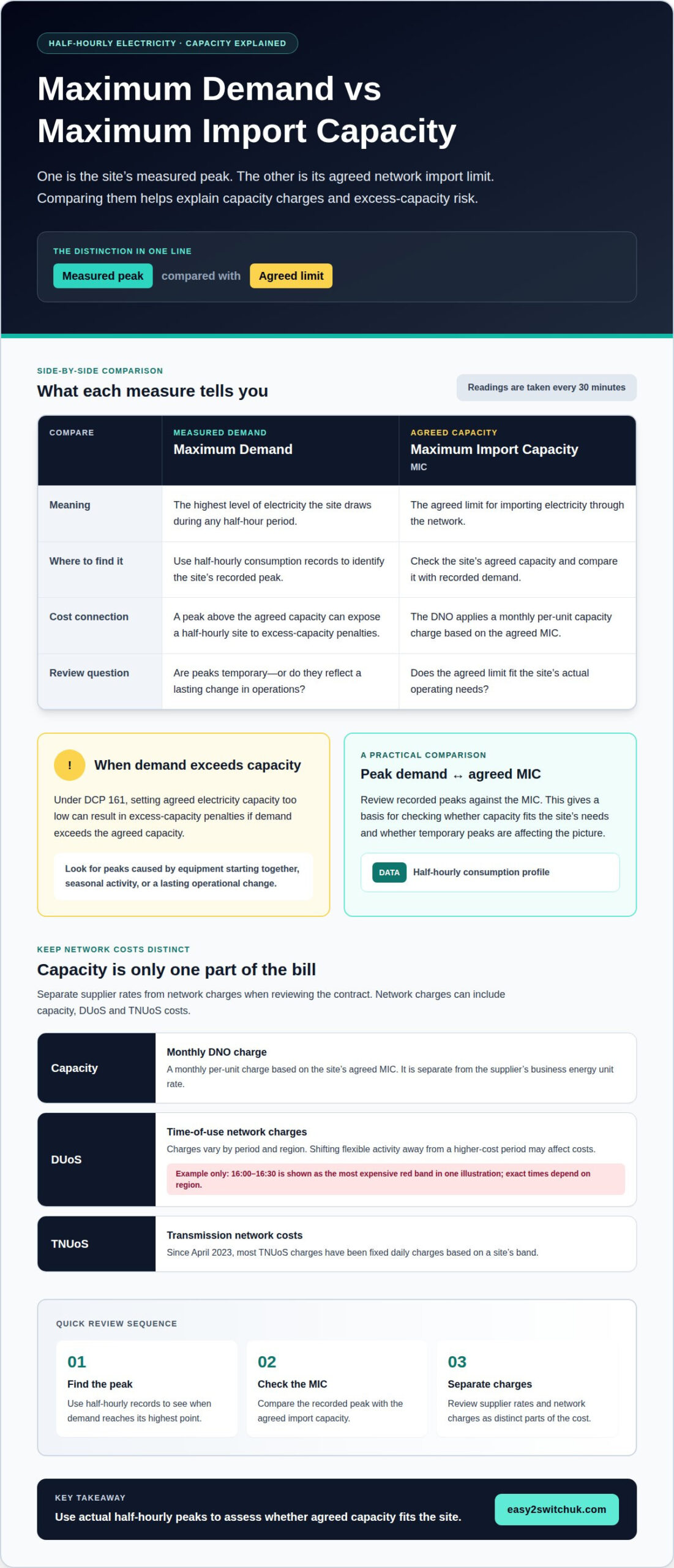
Maximum demand is the highest level of electricity a site draws during a half-hour period. Maximum Import Capacity, or MIC, is the agreed limit for importing electricity through the network. Comparing maximum demand with MIC helps explain capacity charges and whether the agreed supply capacity fits the site’s operating needs.
A Distribution Network Operator (DNO) applies a monthly per-unit capacity charge based on the site’s agreed MIC. This network charge is separate from the supplier’s business energy unit rate, although both can contribute to overall electricity costs. Review the MIC alongside the site’s demand pattern and contract terms, as a higher agreed capacity can affect the charge.
Half-hourly sites can face excess capacity penalties if their demand exceeds their agreed capacity. Under DCP 161, setting agreed electricity capacity too low can result in these penalties. Compare recorded peak demand with the MIC and consider whether temporary peaks come from equipment starting together, seasonal activity or a lasting change in operations. This gives a practical basis for reviewing capacity needs.
Capacity charges are only one part of network costs. Time-of-use Distribution Use of System (DUoS) charges vary by period and region, so shifting flexible activity away from a higher-cost period may affect costs. For example, 16:00 to 16:30 is shown as the most expensive DUoS red band in one illustration, but exact times depend on the region. Check the applicable bands against the site’s half-hourly consumption profile.
Transmission Network Use of System (TNUoS) costs also form part of network charges. Since April 2023, most TNUoS charges have been fixed daily charges based on a site’s band. When reviewing a contract, separate supplier rates from DNO capacity, DUoS and TNUoS charges. Then compare the MIC with actual peaks and consider how operating schedules affect demand across different periods.
Half-hourly settlement and Market-wide Half-Hourly Settlement (MHHS)
Settlement calculates how much electricity suppliers need to account for across the market. Half-hourly settlement uses consumption data for each half-hour, linking a site’s usage more closely to when electricity is supplied. This is a market process, not a change to the physical electricity arriving at a business. Market-wide Half-Hourly Settlement, or MHHS, extends this approach across Great Britain’s electricity meters.
The shift has a history. In April 2017, P272 required businesses in profile classes 05 to 08 to move to half-hourly settlement. That change brought around 160,000 medium-sized business sites into half-hourly settlement. Ofgem approved MHHS in 2021, with Elexon delivering the reform. Unlike the earlier profile-class change, MHHS is designed to move about 33 million electricity meters in Great Britain to half-hourly settlement.
MHHS went live in September 2025, when the industry code changes took effect. UK electricity suppliers started moving meters to half-hourly settlement on 22 October 2025. The industry timetable schedules supplier and agent migrations from October 2025 to May 2027, with the overall deadline for all electricity meters in Great Britain set for May 2027. The industry targets migrating around 80% of meters by October 2026, with the bulk of migrations expected between May 2026 and May 2027.
For a business, the timetable means its meter may move to half-hourly settlement during this wider programme. The change affects how consumption is allocated during settlement, rather than automatically changing the contract’s unit rate. Under the new timetable, settlement is expected to take around four months to finalise rather than 14 months. This can provide more timely settlement information, while contract terms still determine how a business is charged. During the transition, keep meter records and bills together, then compare the recorded usage periods with the supplier’s contract and charges. That practical review helps distinguish settlement changes from tariff changes.
Business electricity contract and tariff options
Half-hourly contracts can structure electricity costs in different ways. A fixed-price contract sets a unit rate for the agreed term, while variable or market-linked pricing can change according to the contract’s terms. Compare options against your consumption patterns, need for budget certainty and ability to manage price movements.
Half-hourly electricity contracts in the UK can last up to five years. A longer term may provide continuity, but it also commits the business for longer. Compare the end date, renewal terms, termination conditions and any price components that can change. The headline unit rate alone does not reveal the full cost structure.
Review all charges alongside the unit rate. Depending on the contract, bills may include standing charges and network costs, such as capacity or time-of-use charges. Compare the same elements across offers using the site’s consumption and half-hourly readings. A business with predictable demand may value price certainty, while one with flexible operations may focus on how the tariff treats usage at different times.
Billing accuracy matters too. Compare billed consumption with meter readings, and separate changes in usage from changes in rates or charges. From October 2024, a broker fee must be shown in the main terms of a UK electricity contract. Read those terms so you can understand how any disclosed broker fee and other charges affect the overall offer.
Before choosing, line up offers using the same site details, contract dates and expected consumption. Then assess price structure, billing terms, capacity arrangements and exit conditions together. This makes the trade-offs clearer than comparing unit rates alone. For support comparing business electricity offers against your site’s usage and contract needs, explore business energy brokerage through Easy2switch UK Ltd.
Easy2switch UK Ltd: Farm Energy Brokerage
Easy2switch UK Ltd can help farms compare electricity and gas contracts through its Farm Energy Brokerage service. If half-hourly readings, capacity charges or contract terms make offers difficult to assess, its brokerage can help identify options suited to your site’s needs.
For other organisations, Easy2switch UK Ltd also provides Business Energy Brokerage and Charity Energy Brokerage. It compares supplier offers and manages the switching process, helping you review contract terms alongside your consumption and operating patterns. Easy2switch UK Ltd earns commission from the energy supplier a customer chooses to switch to.
If you’re considering a new contract, contact Easy2switch UK Ltd to discuss your business energy requirements and take the next step towards comparing suitable offers.
Make your next contract decision with confidence
Use your next renewal to match the contract to how your organisation operates, rather than simply carrying forward familiar terms. Before comparing offers, decide what matters most: predictable budgeting, flexibility or a closer fit with your site’s energy needs. That priority gives you a practical way to assess half-hourly electricity contracts in the UK without letting one headline rate drive the decision.
Easy2switch UK Ltd supports organisations through Farm Energy Brokerage, Business Energy Brokerage and Charity Energy Brokerage. If you’re weighing up your next move, share your requirements and explore the options available for your organisation.
Contact Easy2switch UK Ltd about your contract and take a considered next step towards a contract that fits your needs.
Frequently Asked Questions
What is P272?
P272 was a change that moved eligible UK business electricity supplies to half-hourly settlement. From April 2017, businesses in profile classes 05 to 08 had to move to this settlement approach, and their meters were upgraded to Profile 00. The change brought around 160,000 medium-sized business sites into half-hourly settlement. If your site was affected, check its profile details and settlement arrangements when reviewing billing records.
What is the Capacity Charge?
A Capacity Charge is a monthly Distribution Network Operator charge based on the site’s agreed Maximum Import Capacity. It reflects the capacity reserved for the business’s electricity import, rather than the supplier’s unit rate. Compare the agreed capacity with recorded maximum demand: if demand exceeds the agreed limit, excess capacity penalties may apply under DCP 161. This comparison helps identify whether the site’s network arrangement matches its operating pattern.
What are typical half-hourly business electricity rates and standing charges?
There is no single typical rate or standing charge for every half-hourly business supply. Prices depend on factors such as the site’s consumption, location, contract structure and demand pattern. Compare offers using the same expected usage and contract dates. Check whether network costs appear separately or are included in the quoted terms, so you can assess the whole bill.
How do half-hourly contracts compare with standard business electricity tariffs?
Half-hourly contracts use detailed readings to show when a site consumes electricity, while tariff terms determine how that consumption is priced. A standard business tariff may present charges differently, so compare the underlying rates and billing structure rather than relying on labels. For example, a business that can shift flexible consumption can assess whether time-sensitive pricing fits its operations. Neither contract type is automatically cheaper: suitability depends on usage and terms.
What contract terms, fees, and exit charges should businesses check?
Review the unit rate, standing charge, contract dates, renewal arrangements and conditions for leaving early. Check how any variable or pass-through charges are handled, and whether an exit charge applies if you leave before the agreed end date. Since October 2024, a broker fee must be shown in a UK electricity contract’s main terms. Read those terms alongside the supplier’s charges so you understand what the business may pay throughout the contract.
How do UK electricity network charges and time-of-use costs affect half-hourly bills?
Network charges can add costs beyond the supplier’s energy rate, and some vary by time of use. DUoS time bands differ by region, so the site’s location and consumption periods affect which charges apply. Review network-charge lines against half-hourly readings. For example, compare when flexible equipment runs with the applicable time bands. Separating supplier charges from network costs makes it easier to identify what drives changes between billing periods.
