
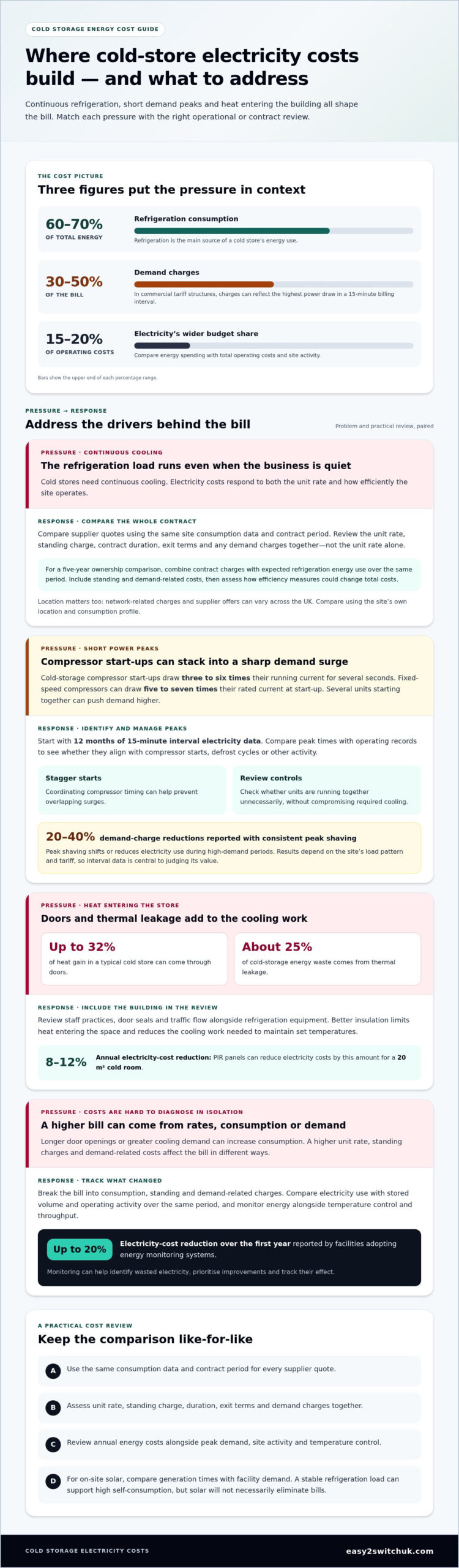
Refrigeration accounts for 60%-70% of a cold store’s total energy consumption, making cold storage facility electricity rates a major cost pressure. Systems run continuously to maintain low temperatures, and electricity represents 15%-20% of cold-storage operating costs.
Cold storage’s constant demand can keep electricity bills high even when other parts of the business are quiet. The unit rate matters, but so does when power is used: demand charges may add costs when equipment draws heavily at the same time.
This guide explains why cold storage uses so much electricity, how demand charges and compressor start-ups affect bills, and what electricity costs mean for operations. It also covers how UK operators can assess energy use and review their contract to help manage costs.
Key Takeaways
- Find out how door traffic, insulation and refrigeration performance can add to a cold store’s electricity use.
- Learn why compressor start-ups can create sharp demand peaks and how managing equipment timing may help control them.
- See how electricity fits into the wider operating-cost picture, alongside the costs that can shape a facility’s budget.
- Understand which site and contract factors influence annual electricity costs for UK cold stores.
Electricity cost pressures for cold storage operators
Refrigeration is the main pressure: it accounts for 60%-70% of total cold-storage energy consumption. Continuous cooling makes the cold chain’s electricity costs sensitive to both unit rates and how efficiently a site operates.
Contract and Supplier Rate Differences
A business electricity contract determines how the unit rate and other charges are calculated during the contract term. Fixed contracts set a unit rate, while flexible arrangements can expose prices to market movements. Supplier quotes vary with contract terms and a site’s consumption profile, so compare unit rate, standing charge, duration, exit terms and any demand charges together. For a fair comparison, use the same usage data and contract period for every quote.
Regional Electricity Rate Variation
Large commercial electricity costs can vary across the UK because network-related charges and supplier offers differ by location. A cold store should compare offers using its own site location and consumption profile, rather than relying on a national headline rate. Regional differences can affect the overall quote even when facilities use similar refrigeration systems.
To compare five-year ownership costs, combine the electricity contract charges with the refrigeration system’s expected energy use over the same period. Include standing and demand-related costs, then assess how efficiency measures could change consumption and total costs. A lower unit rate alone does not show which option costs less overall.
A stable refrigeration load can support high solar self-consumption, so more generated electricity is used on site. Solar may reduce bills, but will not necessarily eliminate them; compare generation times with the facility’s demand. Managing when equipment runs and avoiding unnecessary simultaneous loads can also help reduce peak electricity costs.
UK grants or tax incentives may support energy-efficiency upgrades or on-site renewable power, depending on the scheme, project and business eligibility. Check the relevant conditions as part of the investment comparison, alongside expected energy savings and emissions impacts. These steps help operators judge whether a contract change, efficiency project or on-site generation best addresses their cost pressures.
Demand charges and compressor startup loads
A cold store’s electricity bill can reflect peak power as well as total consumption. In commercial tariff structures, demand charges typically make up 30% to 50% of the bill. They are commonly based on the highest power draw recorded during a 15-minute billing interval, so a short peak can influence charges beyond the moment it occurs.
Refrigeration compressors can create that peak as they start. Cold-storage compressor startups draw three to six times their running current for several seconds. Fixed-speed compressors can draw 5-7 times their rated current at startup. If several units start together, their combined demand may rise sharply, even when their normal cooling load is steady.
Timing and equipment coordination are important for energy efficiency. Staggering compressor starts can help prevent overlapping surges, while reviewing control settings can show whether units are running together unnecessarily. The aim is to reduce short-lived demand peaks without compromising the cooling needed to protect stored goods.
Start with 12 months of 15-minute interval electricity data. This shows when peaks occur and helps connect them with compressor starts, defrost cycles or other site activity. Compare the data with operating records to distinguish recurring patterns from one-off events. Reviewing annual energy costs alongside peak demand helps show whether efficiency changes affect consumption, charges, or both.
Peak shaving means shifting or reducing electricity use during periods of high demand. Cold-storage facilities implementing peak shaving consistently report demand-charge reductions of 20 to 40 percent. The result depends on the site’s load pattern and tariff, so interval data is central to judging its value. A business electricity contract review can help assess how charges are structured alongside these operational measures. Compare business electricity contracts as part of that assessment.
Electricity’s share of cold-storage operating costs
Electricity represents 15%-20% of cold-storage operating costs, making it a major budget line. That share reflects the continuous energy needed for refrigeration, alongside the labour, maintenance and space required to keep stock moving. For an operation, comparing electricity spending with total operating costs shows whether energy consumption is becoming a growing pressure or responding to changes in throughput.
Break the bill down into consumption charges, standing charges and any demand-related costs. Then compare electricity use with stored volume and operating activity over the same period. This helps distinguish a higher unit rate from increased consumption, such as longer door openings or greater cooling demand. Monitoring energy use alongside temperature control and throughput can also reveal savings opportunities without compromising operating requirements.
Building performance can affect that analysis. Air entering through doors can account for up to 32% of heat gain in a typical cold store. Staff practices, door seals and traffic flow therefore matter alongside refrigeration equipment when assessing electricity costs and carbon impact.
The building envelope is another factor: about 25% of cold-storage energy waste comes from thermal leakage. PIR panels can reduce electricity costs by 8%-12% annually for a 20 m² cold room. These figures show why insulation and door management belong in the same cost review as equipment operation. Better insulation limits heat entering the space, reducing the cooling work needed to maintain set temperatures.
Energy monitoring systems can help operators identify wasted electricity, prioritise improvements and track their effect. Facilities adopting these systems often reduce electricity costs by up to 20% over the first year. Comparing consumption before and after a change gives managers a clearer view of its effect on annual energy spending, temperature control and emissions.
What are the average annual electricity costs for UK cold storage facilities?
No single annual electricity bill represents every UK cold store. Costs depend on consumption, the contracted unit rate, site size, temperature requirements and tariff charges. A small chilled store and a large frozen warehouse therefore need different comparisons, even if both operate continuously.
For a useful estimate, multiply annual electricity consumption in kWh by the unit rate, then add standing and demand charges. Use a full year of bills and meter data to capture seasonal changes and operating patterns. When comparing supplier quotes, keep the calculation tied to the same site and contract period.
Energy benchmarks can help assess consumption, but they do not provide a bill in pounds. The Cold Chain Federation calculates specific energy consumption by dividing site electricity use by cold-storage volume, expressed in kWh/m³. Its UK cohorts group stores by cooling volume and whether they mainly handle chilled or frozen products. This offers a more relevant comparison than floor area alone.
Scale matters. The Cold Chain Federation classifies stores below 20,000 m³ as small, those from 20,000 m³ to 100,000 m³ as medium, and those above 100,000 m³ as large. A historical estimate for a low-temperature industrial store of about 100,000 m³ was 30 kWh/m³/yr. Treat that as an energy-use reference, not a current electricity price or a guaranteed level for an individual facility.
For a practical UK cost review, record annual kWh, the unit rate, standing charges and peak-demand costs. Then compare the total against the site’s volume and product temperature needs. This shows whether a high bill reflects the tariff, the amount of energy used, or both. For a contract comparison based on your business’s usage, compare business electricity options.
Easy2switch UK: Farm Energy Brokerage
Easy2switch UK Ltd helps farming businesses compare electricity and gas contracts through its Farm Energy Brokerage. This can be useful when a cold store’s renewal is approaching, or when rising consumption and demand charges make the existing contract worth reviewing. Easy2switch handles the switching process and helps find an appropriate contract from supplier offers.
The same brokerage support is available through Business Energy Brokerage for other businesses, and Charity Energy Brokerage for charities. Easy2switch UK Ltd earns commission from the energy supplier a customer chooses to switch to. Understanding how the brokerage works can help you make an informed decision about reviewing your energy arrangements.
If you’re ready to review your business energy contract, contact Easy2switch UK Ltd.
Make energy decisions part of the operating plan
Make energy decisions part of the annual planning cycle rather than leaving them until a contract deadline. A named owner can bring finance, facilities and operations together before renewal, so changes to stock mix, opening hours or planned equipment work are considered alongside purchasing decisions. This creates a clear record of why the business chose an arrangement and what to revisit next time.
Reviewing cold storage facility electricity rates is most useful as part of a wider operating plan, not simply as a search for the lowest headline figure. Set out your site’s priorities, such as predictable budgeting, flexibility for changing demand or clearer supplier terms. Use them to guide the next conversation and keep decisions consistent as the business develops.
If you’d like support reviewing your energy contract, contact Easy2switch UK Ltd about electricity rates. A considered next step can help you approach future decisions with greater confidence.
Frequently Asked Questions
Why do cold storage facilities use so much energy?
Cold stores use substantial energy because refrigeration continually removes heat entering through walls, ceilings, floors and open doors. The cooling load changes with outside conditions, door traffic, deliveries and the required storage temperature. For example, frequent loading can let warm air into a chilled space, making refrigeration equipment work harder to restore the set temperature.
What are typical electricity rates for cold storage facilities in the UK?
Cold storage facility electricity rates in the UK vary by contract structure, supplier offer, location, consumption profile and agreement terms. No single rate applies to every site. For a useful comparison, use the same annual usage and contract period for each quote, then consider unit rates alongside standing and other applicable charges. This gives a clearer picture than comparing headline rates alone.
What UK electricity network charges, levies and taxes apply to cold storage businesses?
A business electricity bill can include energy costs, network-related charges and applicable levies or taxes. The amounts and how they are presented depend on the tariff and supply account. Review the bill’s breakdown and separate consumption-based items from fixed or capacity-related charges. This helps identify which costs change with usage and which remain payable even when consumption falls.
How do half-hourly metering and peak demand charges affect cold storage electricity bills?
Half-hourly meter data records how a site’s electricity use changes throughout the day, showing when peaks occur. Where a tariff includes demand charges, a brief period of high use can affect the bill beyond the energy consumed at that moment. Compare peak intervals with delivery schedules, defrost cycles and equipment operation to identify what coincided with the recorded maximum.
What factors drive electricity consumption and costs in refrigerated warehouses?
Storage temperature, insulation condition, door opening, product loading and refrigeration controls all affect a warehouse’s electricity use. A busy loading bay, for instance, can increase heat entering the building and add to cooling demand. When assessing cold storage facility electricity rates, consider the contracted price alongside these operational factors. Comparing energy use with stored volume and activity can help pinpoint changes.
How can cold storage facilities reduce electricity use and energy costs?
Start by reviewing refrigeration controls, defrost settings, door seals and equipment timing. Staff can limit avoidable heat entry by reducing door-open time and following consistent loading practices. Check whether refrigeration units are operating efficiently for the current load, rather than running unnecessary equipment. Track consumption before and after each operational change to see whether it reduces energy use.
