
A lower headline rate can still lead to the wrong business energy deal. A business energy basket for SMEs brings together offers to compare, helping businesses review their options. But the contract terms, charges and service behind each offer matter just as much as the rate.
If supplier quotes are hard to compare, renewal dates are unclear or you’re unsure how a broker is paid, you’re not alone. This guide explains what an energy basket means, how to compare electricity and gas offers on consistent terms, and what to review before choosing a contract. You’ll also find out what information to prepare and what happens after you choose an offer.
Easy2switch UK Ltd is an independent energy consultancy, not an energy supplier. Its comparisons and advice are free, with no cost or obligation to obtain a quote. The chosen supplier pays commission, which is built into the tariff. A dedicated personal Account Manager can help you understand the comparison and switching process, so you can make an informed choice.
Key Takeaways
- A business energy basket for SMEs is a set of offers to compare, not a standardised product. The right options depend on whether your premises need electricity, gas or both.
- Compare unit rates, standing charges, contract terms and service details on a like-for-like basis, rather than relying on headline rates alone.
- Understand how a broker is paid: Easy2Switch UK Ltd’s comparisons and advice are free, and the chosen supplier pays commission built into the tariff.
- Gather a recent bill, your current supplier and contract renewal date, plus available usage information, to make your comparison more useful.
- An independent energy consultancy and a dedicated personal Account Manager can support you as you review offers and choose a contract.
What does a business energy basket for SMEs actually mean?
A business energy basket for SMEs is a group of business energy offers assembled for comparison, not a standardised product with fixed features. The term describes a way to organise options and assess how well they fit a business. It doesn’t promise a particular rate, contract or saving.
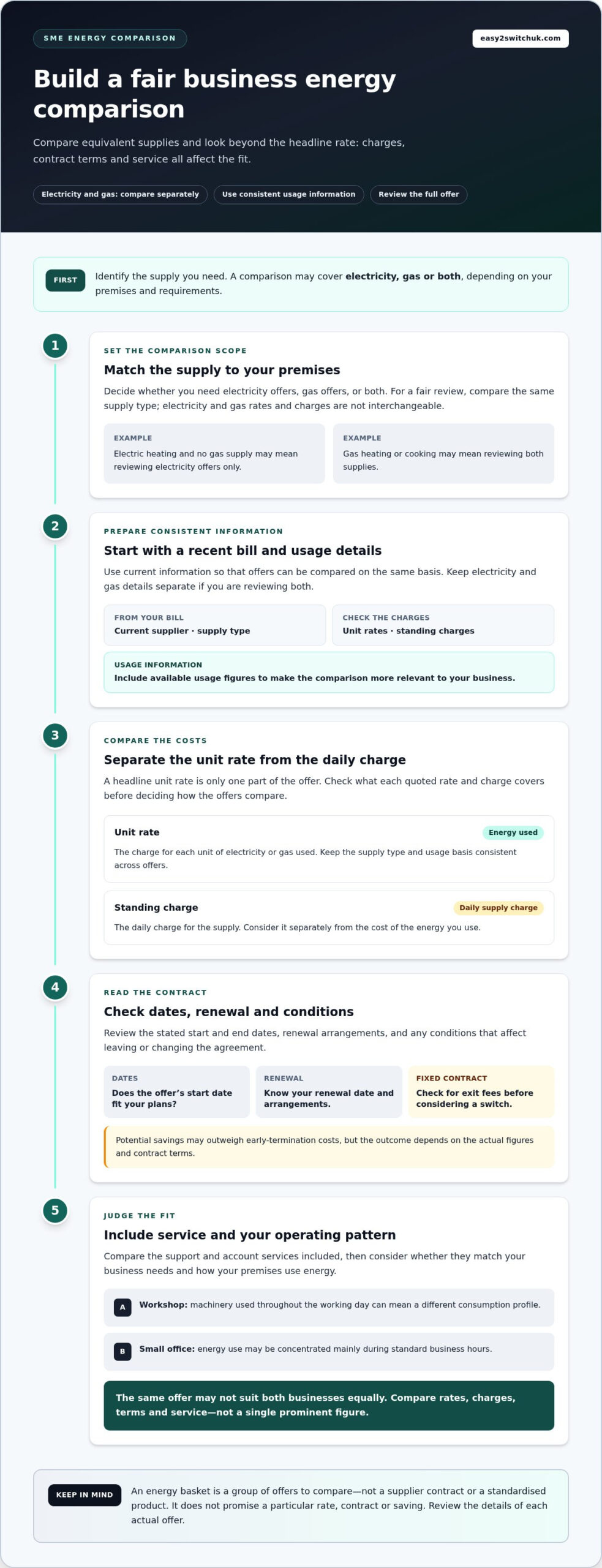
A comparison might cover electricity, gas or both. A business with electric heating and no gas supply may only need electricity offers. A premises with gas heating or cooking may want to review both supplies. The UK energy mix and market provide wider context for business procurement; the Energy in the United Kingdom overview explains how energy sources and consumption fit into that picture.
A comparison basket helps you assess supplier offers; it isn’t itself a supplier contract. A contract is the agreement for a particular supply, with its own rates, terms and conditions. Keeping the distinction clear helps you focus on the actual offer, rather than assuming “basket” refers to a single tariff or buying scheme.
What can an SME energy basket contain?
A comparison can bring together electricity offers, gas offers or both, depending on the business’s supplies and requirements. Offers can differ in unit rates, standing charges, contract terms and account services. Review the details for your business rather than assuming that every offer will suit your needs.
For a fair review, compare the same supply type and use consistent usage information. Check what each quoted rate and charge covers, then read the contract terms and any conditions that affect how the offer works. This makes the basket a practical decision aid, not just a list ranked by one figure.
Why SMEs compare more than the headline rate
A headline unit rate is only one part of a business energy offer. Standing charges, contract terms and the level of support can also affect whether an option suits your needs. If you’re on a fixed contract, check for exit fees before deciding to switch. Potential savings may outweigh early-termination costs, but compare the actual figures and terms rather than assuming.
Operating patterns matter, too. A workshop that uses machinery throughout the working day may have a different consumption profile from a small office that is busy mainly during standard business hours. The same offer may not suit both businesses equally. Use your actual usage information, premises needs and preferred level of contract support to judge the fit.
Think of the basket as a shortlist for an informed decision. Ask what the offer will cost across its rates and charges, which terms apply, and whether the service meets your needs. That’s a more dependable way to choose than treating the lowest-looking headline rate as the whole story.
Which details should SMEs compare across business energy offers?
A fair comparison starts with more than the unit rate. Put the same information side by side for each offer, using current bills and usage details to keep the figures relevant to your business. If you’re reviewing both electricity and gas, compare each supply separately. Their rates and charges aren’t interchangeable.
| What to compare | What to look for |
|---|---|
| Unit rates | The charge for each unit of electricity or gas used. Keep the supply type and usage basis consistent across offers. |
| Standing charges | The daily charge for the supply, considered separately from the cost of the energy you use. |
| Contract terms | The stated start and end dates, renewal arrangements, and any conditions that affect your ability to leave or change the agreement. |
| Service details | What support or account services the offer includes, and whether these match your business needs. |
Build a like-for-like comparison
Use a recent bill to check your current supplier, supply type, unit rates, standing charges and available usage figures. Record electricity and gas separately, even if you’re comparing both at once. If an offer presents information differently, find out what’s included before drawing conclusions. Headline rates alone can’t show whether an offer suits your business, because charges, terms and service also shape the overall fit.
This approach helps you compare equivalent details instead of relying on a single prominent figure. For wider context on business supply, Ofgem’s Non-Domestic Energy Supply Rules page provides guidance for non-domestic energy consumers.
Read the contract terms alongside the rates
Check the contract’s dates and conditions as carefully as its rates. Your renewal date helps you understand when you can review alternatives and whether an offer’s start date fits your plans. Start the review in good time, especially if you need to assess more than one supply.
If you’re on a fixed contract, check for exit fees before considering a switch. Early-termination costs may apply, and potential savings may outweigh them, but the outcome depends on the actual figures and terms. Compare both before deciding. Also check what each offer includes rather than assuming that two quotes with similar rates provide the same service.
Once you have your bills and contract details, a free business energy comparison can help you review available electricity and gas offers. Easy2Switch’s comparison and advice are free, with no cost or obligation to obtain a quote.
How can SMEs judge whether an energy basket is suitable and impartial?
Start by understanding how the comparison is funded and how the options are presented. A broker can provide a comparison and advice at no charge to the business while receiving commission from the supplier a customer chooses. That payment arrangement should be explained clearly, so you can understand the broker’s role and assess each offer on its terms, not on a promise of a particular price.
Easy2Switch UK Ltd’s chosen supplier pays commission, which is built into the tariff. There’s no separate charge to obtain a comparison or advice, and there’s no cost or obligation to receive a quote. Review the tariff’s rates and terms to decide whether it suits your business, with a clear understanding of how the broker is paid.
How does a supplier-paid commission model work?
Easy2Switch UK Ltd compares electricity and gas offers from a wide range of suppliers and receives commission from the supplier selected by the customer. The customer doesn’t pay Easy2Switch UK Ltd directly for the comparison or advice. The supplier-paid commission is built into the chosen tariff. Understanding both parts of this arrangement helps SMEs see how the service is funded before making a decision.
“Free to use” means there’s no charge to the customer for the comparison or advice. The commission is built into the energy tariff, so it’s still important to assess the offer itself. Review the available options and their terms to decide whether an offer fits your business, rather than focusing only on a headline rate or the fact that commission is paid.
What does a trustworthy comparison process look like?
A sound process makes clear who the broker is, how it is paid, what the offer includes and which contract terms apply. It should give you the information to consider your options without presenting a specific rate or saving as guaranteed. Easy2Switch is committed to treating customers with respect, being honest, open and fair, remaining impartial, delivering what it promises and acting in each customer’s best interests.
Use a practical test: can you understand the offer, the broker’s role and the key terms before deciding? If a fixed contract is involved, check for exit fees. Potential savings may outweigh early-termination costs, but compare the actual terms and figures rather than relying on assumptions.
Easy2Switch abides by the Data Protection Act, FCA, TPI Code of Practice, and Business Protection from Misleading Marketing Regulations 2008 (BPMMRs). These commitments, alongside clear information about commission, help explain the standards that guide the consultancy’s approach.
Choosing a business energy basket for SMEs should come down to fit and informed consent: understand how the comparison is funded, review the contract and weigh the offer against your business’s needs. Easy2Switch UK Ltd is an independent energy consultancy, not an energy supplier. Its comparison and advice are free to use.
What should an SME prepare before comparing its energy options?
A little preparation helps make a comparison more relevant to your premises and actual energy use. Before requesting offers, gather your latest bills and current contract details. Note your supplier, whether you need electricity, gas or both, and when your existing agreement ends. Accurate information gives you a clearer basis for reviewing options, but it can’t guarantee a particular rate or saving.
Information to gather before requesting a comparison
Use this short sequence to organise your information. If you’re comparing both supplies, keep the electricity and gas details separate so each can be assessed against the right usage.
- Find recent bills. Use them to identify your current supplier, supply type and available consumption figures, usually shown in kilowatt-hours (kWh).
- Check your contract. Note its renewal or end date and keep the current terms to hand. If you’re on a fixed contract, make a note of any exit fees that may apply.
- Locate supply identifiers if available. Your electricity bill may show the Meter Point Administration Number (MPAN), while a gas bill may show the Meter Point Reference Number (MPRN).
- Record what the business needs. Consider which premises and supplies you’re comparing, and any practical requirements that should guide your choice.
Share the information needed to make the comparison, rather than adding unrelated personal or business details. If a bill is missing or your usage figures aren’t to hand, note what you do have. The aim is to make the review useful and grounded in your circumstances.
How to assess the shortlist for your business
Once you have suitable offers, review them against the information you supplied and your business’s needs. Compare electricity with electricity and gas with gas. Look at rates, standing charges, contract terms and included service details together. Check that the offer’s start and end dates fit your renewal plans, and revisit any exit fees before deciding whether to proceed.
Write down questions as you read. You might want to clarify how a charge is applied, what a contract term means in practice or what support comes with the offer. Getting those points clear makes it easier to judge suitability without treating one headline figure as the whole decision. An SME business energy comparison guide can help you understand the wider comparison process, while a commercial energy broker guide explains the broker’s role.
Easy2Switch UK Ltd’s online quote service takes less than 2 minutes. Its business energy comparisons and advice are free, with no cost or obligation to obtain a quote. Start a business energy comparison when you’re ready to review options using your details.
How Easy2Switch helps SMEs compare and switch energy contracts
Easy2Switch is an independent energy consultancy, not a gas or electricity supplier. It compares business electricity and gas offers from a wide range of suppliers, helping you review options against your premises, usage and contract requirements. The service is free to use, with no cost or obligation to obtain a comparison or advice.
The chosen supplier pays commission, which is built into the tariff. This funding arrangement is explained clearly, so you can consider the offer and its terms with an understanding of the broker’s role. A dedicated personal Account Manager supports you through the process and helps make a complex decision more manageable.
What support does Easy2Switch provide?
Easy2Switch provides comparison and switching support for business energy contracts through a done-for-you process that reduces the administration involved. Your personal Account Manager can talk through offers and contract details with you and provide direct telephone support as you consider the next steps. Support can also include billing and dispute help in most cases, without promising a particular resolution.
The aim is to help you make an informed choice, not to push a one-size-fits-all option. Easy2Switch’s comparisons and advice have no cost to the customer. Over 90% of proposed contracts are accepted. This describes how often proposals are taken up; it isn’t a guarantee of acceptance or a particular result for an individual business.
What happens after an SME chooses an offer?
Once you select an offer, the new supplier handles the switching process. You don’t need to contact your current supplier to arrange the change. Switching usually takes 2-3 weeks, depending on the supplier, and your energy supply continues without downtime or disruption during the transition.
Your existing meters and equipment usually remain unchanged. A meter change isn’t required to switch; it would only be relevant if you choose a smart-meter upgrade. The process is focused on the contract decision, not unnecessary changes to your premises.
Before proceeding, review the contract details and keep a copy of the offer and information about the agreed terms. If you’re on a fixed contract, check for exit fees that may apply to your existing agreement. Potential savings may outweigh early-termination costs, but compare the actual terms before deciding.
A business energy basket for SMEs can make offers easier to assess, while tailored support helps connect the comparison to your needs. Easy2Switch helps you compare offers and manage the transition, with a personal Account Manager supporting you along the way.
Request a free business energy comparison with no cost or obligation.
Make your next energy review a confident one
Your next contract review is a chance to bring energy purchasing into line with how your business operates now, rather than simply rolling forward with familiar terms. Set a reminder ahead of renewal, keep your latest usage information accessible and give yourself time to weigh any offer against your plans. That way, a business energy basket for SMEs becomes a practical tool for a considered decision, not another list of rates to scan under pressure.
Support can make the process easier to manage. Easy2Switch provides a dedicated personal Account Manager with direct telephone support, and its Trustpilot rating is 4.6 from 49 reviewers. Use that support to clarify the details that matter to your business, then decide at your own pace. A comparison is free, with no cost or obligation to obtain a quote.
Get a free business energy comparison and take the next step towards a contract choice that feels clear, considered and right for your business.
Frequently Asked Questions
What is a business energy basket for SMEs?
A business energy basket for SMEs is a practical set of business energy offers to compare, not a standardised product or contract. It can help you assess electricity, gas or both in light of your premises and energy needs. For example, a business with separate workshop and office supplies can use a comparison to review relevant offers. The basket itself doesn’t establish a guaranteed rate or saving; the terms and suitability of the chosen contract still matter.
Is Easy2Switch’s business energy comparison really free?
Yes. There’s no cost or obligation to get a comparison or advice from Easy2Switch. If you choose an offer, the selected supplier pays Easy2Switch commission, which is built into the tariff. You don’t pay Easy2Switch a separate fee for the initial quote. Receiving a comparison doesn’t commit your business to switching, so you can review the information before deciding whether to proceed.
How long does switching a business energy supplier take?
Switching usually takes 2-3 weeks, depending on the supplier. After you choose an offer, the new supplier handles the switching process, so you don’t need to contact your current supplier to arrange it. Your business can continue using its energy supply during the change. Switching doesn’t cause downtime or interrupt the supply, so the transition needn’t interfere with normal operations.
Can an SME compare electricity and gas offers together?
Yes. An SME can compare electricity, gas or both, depending on the supplies its premises use and what it wants to review. If you’re looking at both, keep each supply’s usage and offer details distinct so you can assess the terms clearly. You can consider the options as part of one review, but don’t assume every supplier offers a combined contract or that combining supplies will automatically suit your business better.
Can a business switch while it is on a fixed energy contract?
It may be possible, but check your existing contract and any exit fees before deciding to switch. These costs can affect whether changing supplier makes sense before the fixed term ends. Potential savings may outweigh early-termination costs, but the result depends on your contract and the offers available to your business. Compare the relevant figures and terms first, and don’t treat a possible saving as guaranteed.
Will switching business energy suppliers require a new meter?
In most cases, your meter and other equipment don’t need to change when you switch energy suppliers. A meter change may be relevant if you choose a smart-meter upgrade, but it isn’t a standard requirement of switching. If you’re planning a smart-meter upgrade, treat that as a separate choice from selecting a new energy contract and decide based on your business’s needs.
Does Easy2Switch supply business gas or electricity directly?
No. Easy2Switch is an independent energy consultancy, not a gas or electricity supplier. It compares supplier offers and supports businesses through the switching process. The supplier selected by the customer pays Easy2Switch commission, and that commission is built into the tariff. This means the comparison service and advice are free to use, with no cost or obligation to obtain a quote.
