
If your first thought is “help, I’ve been stuck in a rollover energy contract”, start by confirming what contract you’re actually on. A rollover, an out-of-contract rate and a deemed tariff can mean different things. The label alone won’t tell you whether a new fixed-term contract has started, what rate applies or whether you can switch.
Check your agreement, supplier notices and latest bill, then ask the supplier to confirm your status and terms in writing. Notice requirements and protections can depend on your contract and whether your business qualifies as a microbusiness, so don’t assume the same rules apply to every organisation.
This guide explains how to check key dates, understand the terms that may affect your options and compare practical next steps without rushing into another deal. Easy2switch helps businesses compare offers from hundreds of suppliers and manage the switching process. There’s no separate brokerage fee for the customer: the chosen supplier pays a commission that’s incorporated into the tariff.
Key Takeaways
- If you’re thinking, “help, I’ve been stuck in a rollover energy contract”, check your contract documents and supplier account before deciding what to do.
- Confirm which terms apply to your business, including any notice requirements or protections linked to its customer classification.
- Review realistic next steps, from checking exit terms to planning a future renewal. Don’t assume you can switch immediately.
- Gather your meter details, account information, contract dates and recent bills before contacting your supplier.
- An energy broker can compare supplier offers and help you review contract terms. Check how supplier-paid commission is reflected in the tariff.
Stuck in a rollover energy contract? First find out what you are actually on
If you’re thinking, “help, I’ve been stuck in a rollover energy contract”, it’s understandable to worry about paying an unfavourable rate or being unable to leave. But “rollover” alone doesn’t confirm your current terms or tell you what options are available. First establish whether your old agreement has ended, a new contract has started, or a renewal offer is still awaiting a response.
Compare your signed agreement with renewal notices, your latest bill and recent supplier correspondence. The supplier’s description of your account is a useful starting point, but read the contract terms as well. The supplier market has changed over time; for background on the historic group of major energy suppliers, see this overview.
What does a business energy contract rollover mean?
A business energy contract rollover is when a supplier continues supplying energy after a fixed-term agreement ends, under terms that may differ from the original deal. The applicable rate, length of any new term and exit conditions depend on the agreement and your circumstances. Don’t assume every rollover works the same way.
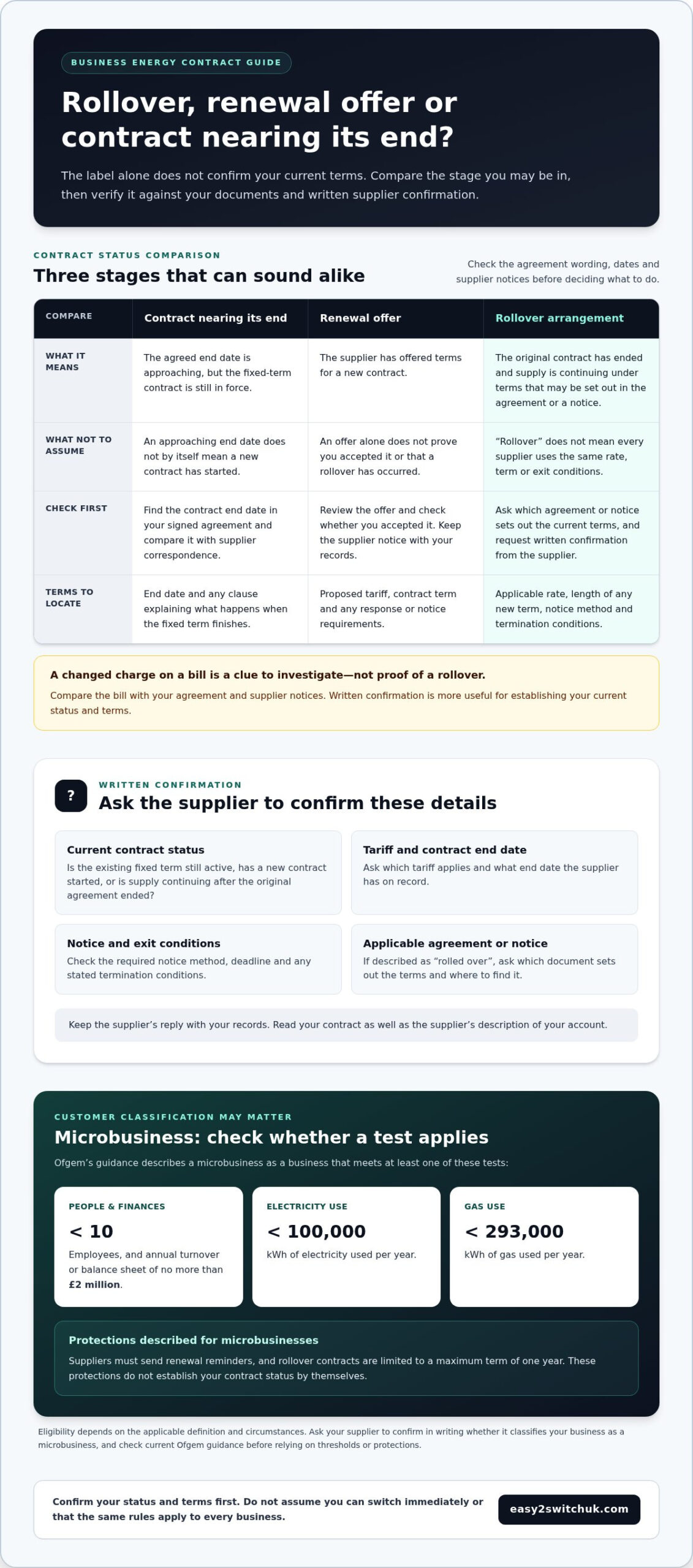
It’s useful to distinguish between these three stages:
- Contract nearing its end: The agreed end date is approaching, but the existing fixed-term contract is still in force.
- Renewal offer: The supplier has offered terms for a new contract. An offer alone doesn’t prove you’ve accepted it or that a rollover has occurred.
- Rollover arrangement: The original contract has ended and supply is continuing under terms that may have been set out in the agreement or a notice.
These labels don’t replace the contract wording. Look for the end date, any renewal or continuation clause, and how the rate and termination conditions are described.
How can I check whether my contract has rolled over?
Compare the end date in your agreement with the dates and wording in supplier notices and on your latest bill. Check whether the bill shows a new tariff or contract reference, but don’t treat a changed charge on its own as proof of a rollover. Billing details can show what to investigate; the agreement and written supplier confirmation are more useful for establishing the terms.
Ask your supplier in writing to confirm your current contract status, tariff, contract end date and any notice or exit conditions that apply. Keep the reply with your records. If the supplier describes your account as “rolled over”, ask which agreement or notice sets out the terms and where to find it. You’ll then have a clearer basis for deciding what to do next, without rushing into another deal.
Rollover rules and microbusiness protections: what applies to your contract?
Business energy protections aren’t identical for every customer. The rules that may apply can depend on your business’s size and energy use, its customer classification and the wording of its agreement. If you’re thinking, “help, I’ve been stuck in a rollover energy contract”, don’t assume that a rule mentioned online automatically gives you a particular right to leave.
Ofgem’s guidance describes a microbusiness as a business that meets at least one of these tests: it has fewer than 10 employees and an annual turnover or balance sheet of no more than £2 million; it uses less than 100,000 kWh of electricity a year; or it uses less than 293,000 kWh of gas a year. Check Ofgem’s current official rules on business energy contracts before relying on these thresholds or any protection linked to them.
Does being a microbusiness change rollover rules?
It can. Under the protections described for microbusinesses, suppliers must send renewal reminders, and rollover contracts are limited to a maximum term of one year. These rules don’t establish your contract status by themselves. Eligibility depends on the applicable definition and circumstances, so ask your supplier to confirm in writing whether it classifies your business as a microbusiness and what information it used to make that assessment.
Keep the reply with your records. If the supplier’s classification seems inconsistent with your employee numbers, turnover, balance sheet or annual energy use, ask it to explain its reasoning. Check current Ofgem guidance to verify the criteria and protections before acting.
Which contract terms should I read before acting?
Regulatory protections and contractual notice requirements are related, but they’re not interchangeable. A protection may apply to a particular customer category, while your agreement sets out practical details such as how to give notice and where to send it. Don’t assume a specific notice period or exit right applies to every business.
Read the clauses covering:
- Contract end date: Check when the current fixed term finishes.
- Renewal or rollover: Look for what happens if you don’t accept an offer or give notice.
- Notice method and deadline: Check whether notice must be written and how the supplier requires it to be delivered.
- Termination conditions: Note any stated conditions, charges or restrictions before taking action.
Check whether and when a renewal notice was sent, and keep copies of it and related correspondence. For calls, record the date, the person or team you spoke with, what was said and any reference number. If you’re reviewing supplier offers while clarifying your terms, business energy contract comparisons can help you consider your options without treating one set of rules as universal.
Can you leave a rollover energy contract? Compare your realistic options
A rollover doesn’t automatically mean there’s no next step. Your options depend on your current contract, its terms and the supplier’s processes. If you’re thinking, “help, I’ve been stuck in a rollover energy contract”, confirm the facts before assuming you must stay or trying to switch straight away. Rates, fees, eligibility and possible switching dates can all depend on your agreement.
Use this comparison to identify what to investigate next. Ofgem’s guidance on Ofgem regulations can help you understand the broader framework, but your contract and circumstances matter too.
| Action | What to verify | Likely next decision |
|---|---|---|
| Check exit terms | Whether the agreement sets out a notice route, termination conditions or charges, and when they apply. | Decide whether you can give notice now or need to clarify a term first. |
| Discuss the account with your supplier | Current contract status, the basis for any new term, its start and end dates, and the supplier’s stated exit terms. | Compare the explanation with your agreement and renewal correspondence. |
| Plan a future renewal | Your next valid notice or renewal window, plus the dates and process specified in your contract. | Diary the key dates and compare suitable offers in time to make an informed choice. |
What if the supplier says I am locked into a new term?
Ask the supplier to identify the contractual clause it relies on and confirm the new term’s start date, end date and applicable exit conditions in writing. Compare that explanation with your original agreement and any renewal notices. If there’s a material disagreement, raise a formal complaint with the supplier and keep copies of your messages and its responses. Don’t rely on a verbal explanation alone.
Should I switch now or prepare for my next renewal?
That depends on your confirmed contract status, its terms and the supplier’s switching process. If your agreement provides a route to leave, you can explore it, but don’t assume a switch can happen immediately or will produce savings. If you can’t leave under the current terms, note the next valid renewal or notice window so you can compare options before the relevant deadline.
Take it one step at a time: confirm the terms, get the supplier’s position in writing, then decide whether to act now or prepare for later. That keeps your next move grounded in the contract rather than pressure or guesswork.
What to Do Now: Rollover Energy Contract Checklist
If you’re asking, “help, I’ve been stuck in a rollover energy contract”, take this one step at a time. A clear record of your account and the supplier’s explanation will help you understand your position and choose a practical next move.
What information should I gather before contacting my supplier?
Bring the key details together first. Find your signed agreement, renewal communications, latest bills and account reference. Note your supply address, meter details, the date the agreement began and its stated end date. Having these details to hand helps you ask focused questions and compare the supplier’s reply with your records.
- Collect your documents. Save the signed contract, renewal offers or notices, recent supplier correspondence and latest bill. Keep digital or paper copies together.
- Record account and supply details. Note the account reference, supply address and meter details shown on your bill, such as the meter serial number.
- Write down key dates. Record when the current agreement began, its stated end date and when any renewal notice arrived. If dates differ across documents, flag them for clarification.
- Prepare specific questions. Ask the supplier to confirm your current tariff, contract status, term and end date. Request details of any notice method, exit conditions or other requirements that apply to your agreement.
- Contact the supplier through a recorded channel. Use a method that gives you a copy or reference for the enquiry. Note the date, the representative’s name or team, and the reference number.
- Save the written response. Check that the supplier has answered each question and keep its reply with your contract documents. If something is unclear, ask for the missing detail in writing.
How should I document a rollover query or complaint?
Keep a simple timeline of calls and messages, including what was discussed and any promised follow-up. If you make a formal complaint, retain the complaint and the supplier’s response. Escalation routes depend on the issue, your business’s eligibility and current guidance, so check the applicable process rather than assuming one route fits every customer.
With your records organised, you can assess the supplier’s explanation without relying on memory or making a rushed decision. If you’re ready to review business energy options alongside your contract details, compare business energy offers with Easy2switch.
How an energy broker can help you review a rollover and plan ahead
Once you’ve checked your current status and gathered your documents, an energy broker can help you assess what to do next. If you’re still thinking, “help, I’ve been stuck in a rollover energy contract”, a broker can compare available supplier offers and explain key differences. Your existing agreement determines whether and when you can move.
What can Easy2switch help with after a rollover?
Easy2switch helps businesses review energy options, compare offers from hundreds of suppliers and manage the switching process. You can access support online or by telephone. A comparison can bring the details into view, but it can’t change the terms of your current contract or guarantee that a switch is possible immediately.
Look beyond the headline unit rate. Compare the tariff structure, standing charges, contract length and relevant terms, then consider how each offer fits your business’s energy use and timing. If your existing agreement has exit conditions or a notice window, factor those into your decision before accepting a new offer. The aim is to understand the whole deal, not to rush towards the lowest-looking figure.
How is a free energy brokerage service funded?
Easy2switch doesn’t charge the customer a separate brokerage fee. The chosen energy supplier pays a commission, which is incorporated into the selected tariff. Understanding this funding model gives you a clearer basis for reviewing an offer and its tariff terms side by side.
Broker support helps you compare offers and make an informed choice. It doesn’t promise the lowest rate or a particular saving. Read the full terms and decide whether the offer suits your business, taking account of your current contract status and any applicable switching dates.
If you’ve confirmed your current position and are ready to explore what may fit next, take a measured first step: Review your business energy options with Easy2switch.
Take control of your next energy decision
If you’re still thinking, “help, I’ve been stuck in a rollover energy contract”, remember that the label alone doesn’t tell you what you can do next. Confirm your current contract status, check the terms and any protections that may apply to your business, then get the supplier’s position in writing. A clear record gives you a reliable basis for deciding whether to explore options now or prepare for a later renewal window.
You don’t have to compare offers alone. Easy2switch reviews business energy options from hundreds of suppliers and can support you online or by telephone. There’s no separate brokerage fee for you: the chosen supplier pays commission that’s incorporated into the selected tariff. Compare the full terms, not just the headline rate, and choose a deal that fits your circumstances.
Review your business energy options with Easy2switch when you’re ready to take the next step. A calm, informed decision can help you feel more in control of your energy contract.
Frequently Asked Questions
What is a rollover energy contract?
A rollover energy contract is an arrangement where a business continues receiving energy after its existing agreement ends, under terms set out by the supplier and contract. The rate or duration may differ from the previous deal. Check your agreement, renewal notice and latest bill before assuming which terms apply. If anything is unclear, ask your supplier to confirm your current contract status in writing.
Can I get out of a business energy rollover contract?
Possibly, but your options depend on your agreement, customer classification, current rules and the supplier’s terms. Ask the supplier in writing to confirm your contract dates, any applicable notice requirements and available exit options. Don’t assume every rollover has the same duration or that switching can happen immediately. Review the response alongside your contract before deciding whether to act now or plan for a later date.
What should I do if my business energy contract has already rolled over?
Gather your agreement, renewal notice and latest bill, then ask the supplier to confirm your current tariff, contract status, end date and any exit terms. Keep a copy of its written response. If you’re thinking, “help, I’ve been stuck in a rollover energy contract”, take one step at a time: once you understand the terms, consider whether an available change or a planned switch later is the better fit.
Do microbusinesses have different rollover protections?
Some business energy protections depend on whether a customer meets the current microbusiness criteria. Eligibility and rules can change, so check current Ofgem guidance and ask your supplier to confirm how it classifies your business and the basis for that decision. Don’t rely on a general online summary alone. Consider your contract wording and account circumstances too, as these can affect which terms and next steps apply.
Can my energy supplier roll my business onto a new contract without asking?
The answer depends on your contract, your circumstances and the rules that apply. Review the agreement and renewal communications to see what they say about the end of the term and what may happen if you take no action. Ask the supplier to identify the relevant terms and explain its position in writing. Then compare that explanation with your documents before deciding what to do.
Will switching energy suppliers interrupt my business supply?
A supplier switch is generally an administrative change rather than a physical change to the energy supply. However, timing and eligibility depend on your contract and the supplier’s process. Before proceeding, confirm the proposed start date and whether any account requirements remain unresolved. Don’t cancel your existing supply arrangements based only on an assumed switching date. Keep written confirmation of the arrangements and dates for your records.
Is an energy broker free to use for a business?
Easy2switch doesn’t charge the customer a separate brokerage fee. The chosen energy supplier pays a commission, which is incorporated into the selected tariff. Ask for clear information about the offers and their terms, then compare the full contract details rather than judging an option by one rate alone. Check that the proposed tariff and contract conditions suit your business before deciding whether to proceed.
How can I avoid being stuck in another rollover contract?
Record your contract end date and set reminders well ahead of the renewal or notice period stated by your supplier. Read renewal communications promptly, compare suitable offers and keep written confirmation of any decision you make. Notice requirements can vary, so check your own agreement and current rules instead of relying on a generic timetable. Keeping key dates and documents together makes it easier to plan your next renewal.
