
Could your business use less energy this year and still face a higher bill? A lower meter reading doesn’t always mean lower costs, especially when network and policy charges change. This annual energy review checklist for UK businesses helps you look beyond the total on an invoice and understand what’s driving your energy use.
Year-on-year comparisons can be misleading if opening hours, equipment, weather or production levels have changed. A structured review gives you a clearer picture: compare consumption over a consistent period, investigate unusual patterns, record operational changes and check that bills match your contract. It also helps you review renewal dates and terms in good time, including any exit fees on a fixed contract.
Use the checklist to turn your findings into practical next steps, whether you run a farm, charity, office or other business. At the contract-review stage, Easy2switch UK Ltd can provide free comparison and advice, with supplier-paid commission built into the chosen tariff. The sections ahead cover which records to gather, what to look for in your energy data and how to assess whether your contract still suits your needs.
Key Takeaways
- Use the annual energy review checklist for UK businesses to create a repeatable process that fits your organisation.
- Gather bills, meter readings, usage reports and operating calendars before comparing periods, so you can account for changes in activity.
- Review electricity and gas contract terms alongside your business’s actual usage and renewal dates.
- Turn findings into clear next steps by prioritising actions, assigning owners and setting progress-review dates.
- Easy2Switch UK Ltd can support the contract-review stage with business energy comparison, contract support and a done-for-you switching process.
What an annual energy review checklist helps a UK business understand
An annual energy review gives your business a planned way to examine energy use, operational demand, bills and contract suitability. Bringing these questions together makes unusual patterns and decisions requiring follow-up easier to spot. The annual energy review checklist for UK businesses should be practical enough to repeat, but flexible enough to reflect how your organisation operates.
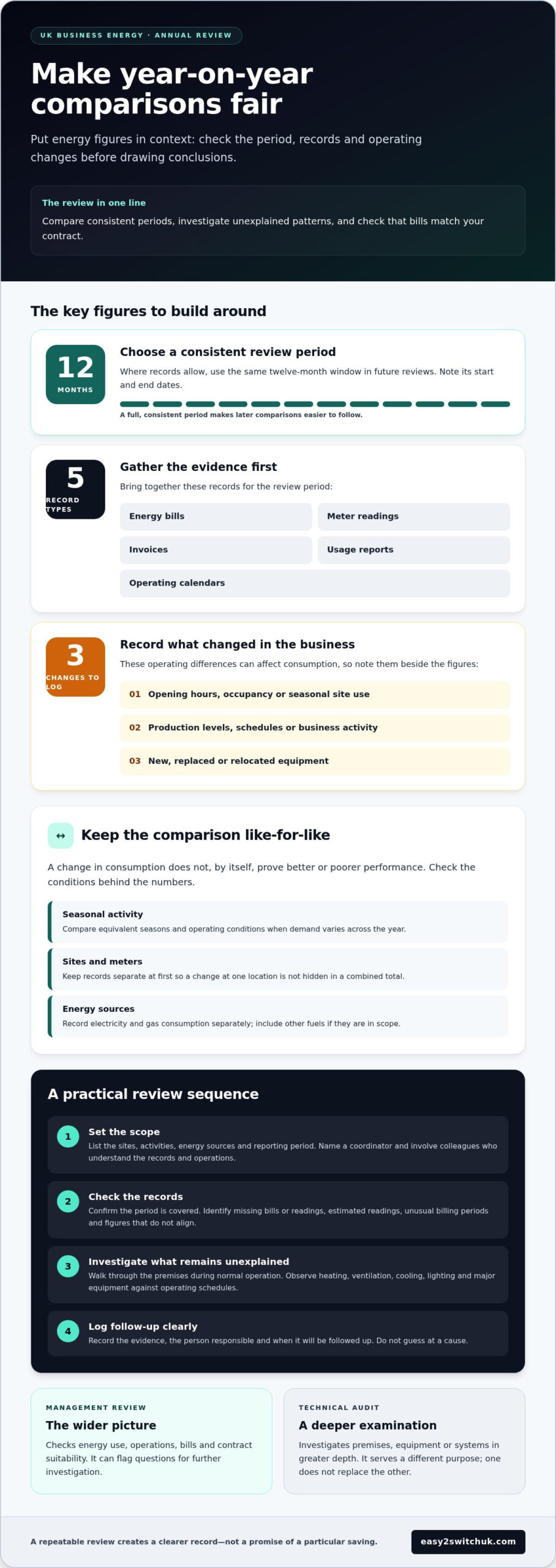
An annual management review checks energy use, operations, bills and contract suitability; a specialist technical audit investigates premises, equipment or systems in greater depth. The two serve different purposes. A management review can flag questions for further investigation, while a technical audit can examine specific systems in detail. One doesn’t replace the other.
You can adapt the checklist for farms, offices, charities, manufacturers and other organisations. A farm might track seasonal activities and buildings with different uses; an office might account for occupancy and opening hours; a manufacturer might consider changes in production. The review can also put day-to-day energy decisions in the wider context of the Energy policy of the United Kingdom, including its focus on emissions, energy intensity and reliable supply.
Set the review scope before gathering information
Decide what the review covers before comparing figures. If your business has several sites, list the locations included and decide whether to review them together or separately. Note the activities and energy sources in scope, such as electricity, gas or other fuels, and set out the reporting period.
Name a coordinator to keep the process moving, then involve colleagues who understand the figures and the work behind them. Finance can help interpret invoices, facilities colleagues can explain building use, and operational staff can describe changes in activity. Record relevant changes, including:
- Opening hours, occupancy or seasonal use of a site.
- Production levels, operating schedules or changes to business activity.
- New, replaced or relocated equipment that may affect demand.
These notes give the numbers context. Without them, it may be difficult to interpret a rise or fall in consumption fairly.
Choose a useful annual review period
Where records allow, choose a consistent twelve-month period and note its start and end dates. Use the same dates in future reviews where practical, so comparisons are easier to follow. If a site’s activity is strongly seasonal, compare equivalent seasons and operating conditions rather than assuming two different periods are directly comparable.
For example, a period that includes a busy production season may not be a fair comparison with one when activity was reduced. Weather exposure, occupancy and operating patterns can also affect the figures. Record these differences rather than treating a change in consumption as proof of improved or poorer performance.
Make the review a recurring management practice, not a promise of a particular saving. Its value is in creating a clearer record, identifying questions worth investigating and helping your business decide what to examine next.
Gather and interpret energy data before inspecting business operations
Start with records, not assumptions. Collect energy bills, meter readings, invoices, usage reports and operating calendars for the review period. If you have several sites or meters, keep their records separate at first so that a change at one location doesn’t disappear inside a combined total. The annual energy review checklist for UK businesses works best when it connects consumption figures to the dates, sites and activities they represent.
Consumption comparisons are useful only when you consider the operating conditions behind the numbers. A change in usage could reflect altered opening hours, occupancy, production or weather exposure, but the figures alone won’t establish the cause. Annotate known changes alongside the data, then investigate any differences that remain unexplained.
Build a clear picture from bills and usage records
For the selected period, record electricity and gas consumption separately. Note each meter identifier and the dates covered by readings or bills. Mark readings shown as estimated, and keep invoice amounts and usage reports alongside the relevant billing period. This helps distinguish a change in consumption from a difference in billing dates or an incomplete record.
- Check that the records cover the full review period and identify missing bills or readings.
- Flag unexpected changes, repeated estimates, unusual billing periods or figures that don’t align across records.
- Record what needs follow-up, who will handle it and when. Don’t guess at a cause.
A gap or unusual figure doesn’t automatically mean there’s a fault or billing error. Note the evidence and follow it up through the appropriate account or billing support channel. For questions about your contract or bill, business energy contract support can help with the contract-review side.
Walk through premises and major energy uses
Once you’ve assembled the records, walk through the premises during normal operating conditions. Observe heating, ventilation, cooling, lighting and major equipment in use. Compare what you see with operating schedules. Are systems running during expected hours, or are there idle periods worth investigating? Record observations without assuming they explain a specific change in consumption.
Note visible maintenance concerns and possible opportunities for investigation, such as equipment running when an area is unoccupied. A walk-through isn’t a technical diagnosis. It helps identify questions to pass to the person responsible for facilities or maintenance.
Ask staff who use the spaces or equipment about recurring patterns. They may know when machinery typically runs, when rooms are occupied or whether schedules have changed. Keep the conversation practical and blame-free. The aim is to understand how work gets done, then connect that context to the records. This gives you a sound basis for deciding what deserves closer investigation.
Review business energy contracts alongside usage and billing
Energy records show what your business used; contract documents show the agreed arrangement behind its bills. Review them together for electricity and gas, rather than treating a tariff comparison as a stand-alone decision. The annual energy review checklist for UK businesses should help you identify what matches current needs, what needs clarification and what to consider before renewal.
Check contract details and billing consistency
Gather the relevant contract documents and note the supplier, contract dates, renewal terms, charges and other agreed terms. Compare these details with bills and consumption records for the same periods. Check that dates align and billed consumption appears consistent with the readings and usage information you have. A difference is a prompt to investigate, not proof of an error.
Keep a record of missing documents, unclear terms or billing questions. Note the period affected, the evidence available and the next step, such as following up through the appropriate account or billing support channel. If there’s a billing dispute, record its status and any response so it doesn’t get lost among renewal decisions.
| Review area | Record | Follow-up |
|---|---|---|
| Usage findings | Consumption by fuel, site and period | Compare with the business’s operating pattern |
| Billing questions | Bill dates, charges and any gaps or differences | List points needing clarification |
| Contract points | Supplier, dates, renewal terms and agreed charges | Flag terms to review before renewal |
| Next actions | Evidence, owner and follow-up date | Track each question to resolution |
Assess whether the current arrangement still fits
Consider whether the contract suits the business as it operates now. A change in site use, opening hours or production pattern may alter what matters in an arrangement, even if the contract terms haven’t changed. Note foreseeable changes too, such as a planned move or altered operating schedule, and factor them into the review without assuming they point to one particular contract outcome.
Renewal timing depends on the terms of the specific agreement, so don’t assume every business has the same switching window. Record the relevant dates and allow time to understand the available options before a decision is due. Supplier comparisons can help you assess competitive options and contract suitability, but they can’t guarantee a particular price or outcome.
If you’re considering leaving a fixed contract early, check the exit fees first. Potential savings may outweigh early-termination costs, but compare the figures and terms carefully before deciding. For support with the contract-review and comparison stage, Easy2Switch UK Ltd offers business energy contract support alongside business electricity and gas comparison. This connects your contract decision to the usage and billing questions identified in your review.
Turn annual review findings into an actionable business energy plan
A review is useful when it leads to clear, owned actions. The annual energy review checklist for UK businesses can help turn observations into a plan without treating every unusual reading as an immediate project. Separate quick operational checks, such as confirming equipment schedules, from work that needs planning, such as maintenance, investment or a contract decision. For organisations looking to align energy efficiency with wider sustainability, climate impact and policy goals, advisory specialists like Symolem offer strategic guidance.
A useful action item names an owner, sets out the next step and gives it a review date. That structure makes progress easier to track and helps prevent unresolved questions from disappearing until the next annual review.
Use this sequence to build your plan:
- Prioritise the findings. Rank each item by relevance to the business, urgency, practicality and strength of the available evidence. Address safety or business-continuity concerns through the appropriate internal process.
- Choose the next step. State what needs to happen, such as checking an operating schedule, investigating a billing question or assessing a maintenance concern. Record any information or decision the action depends on.
- Assign an owner. Name the role responsible for moving the item forward, such as facilities, finance or an operational lead. Make accountability clear without assuming one person can resolve every issue.
- Set a target and review date. Choose a realistic date for the next step and a separate date to check its status or outcome. Carry forward actions that depend on longer-term planning.
- Record evidence and revisit results. Keep relevant readings, correspondence, work records or decisions with the action. At review, note what changed and whether another step is needed.
Choose indicators that relate directly to each action. These might include recorded consumption over a defined period, whether planned maintenance was completed or whether a billing query was resolved. Don’t assume an action will deliver a specific reduction; use the evidence to understand what happened.
Prioritise findings and assign responsibility
Distinguish immediate operational checks from decisions that need more time. A schedule check may be straightforward, while maintenance work or an investment decision may depend on further assessment or approval. Record dependencies plainly, such as a missing usage report or a decision awaiting internal review. Avoid adding cost or savings estimates unless your business has reliable evidence to support them.
Keep the checklist useful between annual reviews
Store the baseline, source records, decisions and open actions together somewhere relevant colleagues can access. Schedule an interim review if operations or energy arrangements change materially, rather than waiting for the annual cycle. At the next review, bring forward unfinished actions and record what changed, what remains open and why. This creates a working record, not just a once-a-year snapshot.
For help turning contract questions into a practical next step, review business energy options with Easy2Switch UK Ltd.
How Easy2Switch can support the contract-review and next-step process
An annual review may identify contract questions that need specialist attention. Easy2Switch supports the business energy contract side, not a technical premises audit. Its service includes comparing business electricity and gas options, reviewing contract details and supporting the switching process when a business decides to proceed. This gives you a practical route from review findings to a considered contract decision, while keeping operational and technical investigations separate.
What business energy brokerage can help with
Easy2Switch compares offers from a wide range of suppliers to help businesses consider competitive options against their needs and contract terms. Quotes and advice are free to access. Suppliers pay commission, which is built into the chosen tariff, and Easy2Switch is independent from energy suppliers. A dedicated personal Account Manager provides telephone support, making contract questions and next steps easier to manage.
Any fees for ongoing broker services are agreed in advance and paid quarterly by the customer. This is separate from accessing quotes and advice. Easy2Switch commits to treating customers with respect, being honest, open and fair, remaining impartial, delivering what it promises and acting in customers’ best interests. It abides by the Data Protection Act, FCA, TPI Code of Practice and Business Protection from Misleading Marketing Regulations 2008.
If the contract findings point to a comparison, explore business energy comparison and support with Easy2Switch.
What to expect if the review leads to switching
Switching usually takes 2-3 weeks, depending on the supplier. The new supplier handles the switch, and your energy supply continues without downtime. In most cases, meters or other equipment don’t need to be changed. A smart-meter upgrade is optional, not a standard requirement of switching.
Before moving away from a fixed contract, check its terms and any exit fees. Potential savings may outweigh early-termination costs, but compare the figures with the fees and remaining obligations before deciding. A supplier comparison is a decision aid, not a promise of a particular outcome. Consider how each option fits your business’s usage, sites, operating patterns and renewal timing, as well as the charges and terms set out in the offer.
Once you’ve chosen an option, the done-for-you switching process can take the administrative steps off your team’s hands. Your Account Manager can support you through the contract process, so your decision is based on the review’s findings rather than a rushed renewal. Keep the chosen terms and key dates with your energy records to inform the next annual review.
Make your next energy decision with confidence
Put your review in the business calendar, then use its findings to guide decisions as circumstances change. A new operating pattern, an upcoming renewal or an unresolved question can all prompt a timely check before the next annual cycle. Keep the process proportionate: focus on the issue that matters now, decide who will move it forward and record what you learn.
The annual energy review checklist for UK businesses is most useful as a working tool, not a document that’s filed away. Each decision adds context for the next one, helping your team build a clearer understanding of its energy arrangements over time.
If your review has brought a contract decision into focus, take the next step with Get a free business energy comparison and practical contract support. Explore your options and move forward at a pace that suits your business. A considered next step can make energy management more straightforward.
Frequently Asked Questions
Is an annual energy review legally required for every UK business?
No, there isn’t a general requirement for every UK business to complete an annual energy review. Separate obligations can apply to organisations that meet the criteria for schemes such as the Energy Savings Opportunity Scheme (ESOS), so don’t treat a routine management review as proof of compliance. The annual energy review checklist for UK businesses is a practical management tool; check current scheme requirements separately if your organisation may qualify.
Can a business review energy use if it has several sites?
Yes. Give each site its own record of meters, bills and relevant activity, then create a combined view for the organisation. This helps you see whether a change is isolated to one location or appears across several. For example, if a total rises, site-level figures can show whether one building accounts for most of the difference. Keep site boundaries consistent between review periods to make comparisons meaningful.
How should a business compare energy use when its operating hours have changed?
Show both total consumption and a relevant activity measure, such as consumption per open hour, where reliable operating-hour records are available. Compare like-for-like days or shifts where practical, and mark when the schedule changed. For example, extending evening opening can raise total use even if energy use during each operating hour is steady. Treat the adjusted figure as context for investigation, not a definitive explanation.
Does an annual energy review include water bills?
It can, if the business chooses to include water as a separate utility in its wider review, but water isn’t energy consumption. Keep water charges and usage distinct from electricity and gas so the figures remain clear. A combined review may help finance teams see utility spending in one place, while separate records make it easier to identify which service a question relates to. Easy2Switch also provides water deregulation guidance.
Can a farm or charity use the same annual energy review checklist?
Yes. Use the same basic structure, then tailor the records and comparisons to the organisation’s work. A farm might track energy use across different activities or buildings over seasonal cycles; a charity could consider how service schedules and occupied spaces vary during the year. The aim is to reflect actual operations, rather than force every organisation into identical categories or assumptions.
Can a business review a fixed energy contract before it ends?
Yes. Reviewing the agreement ahead of its end date gives the business time to understand renewal terms and consider its options. If you’re thinking about leaving before the fixed term ends, check the contract’s exit fees and compare them with any potential savings, which may outweigh early-termination costs. Don’t assume the same timing or conditions apply to every contract; use the dates and terms in your own agreement.
